Couch repair is not worth it when the frame is structurally compromised, the furniture is mass-market quality, or the repair cost exceeds 50% of what a comparable new sofa costs. The industry calls this threshold the 50% Rule, and it is the single most reliable benchmark for couch repair cost analysis. A sofa with solid hardwood joinery and corner blocks can justify reupholstery that runs $1,500 or more. A particle board frame from a budget retailer rarely can. This guide walks you through the exact criteria, current 2026 cost benchmarks, and a practical decision framework so you can make the call with confidence.
When couch repair is not worth it: the core criteria
The repair-versus-replacement decision starts with the sofa’s structure, not its fabric. Expert upholstery professionals consistently point to the frame, joinery, and suspension as the deciding factors. Worn fabric is cosmetic. A failing frame is a structural problem that no amount of new upholstery can fix.
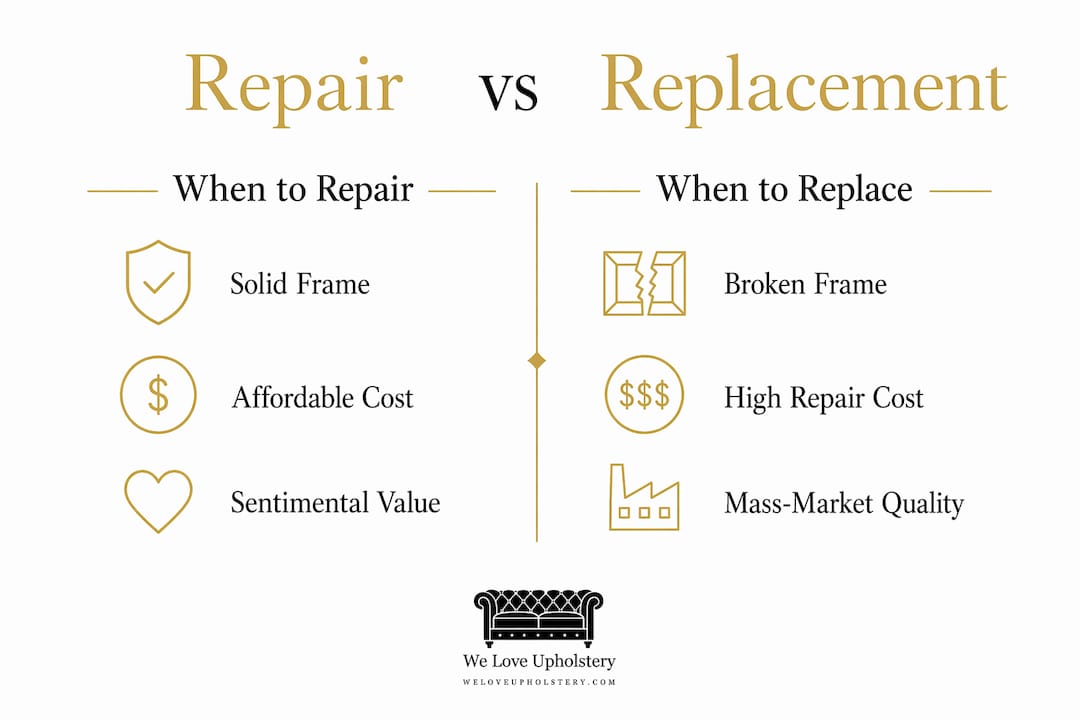
Three conditions make couch repair not worth it in almost every case. The frame is cracked, warped, or built from particle board or engineered wood. The repair estimate exceeds half the price of a new sofa of equivalent quality. The sofa is a mass-market piece under $1,500 that is already more than 10 years old. If your couch checks any two of these boxes, replacement is almost always the smarter financial move.
Sentimental value and heirloom status are legitimate exceptions. A mid-century piece with solid walnut joinery or a family heirloom with irreplaceable provenance can justify repair costs that exceed the 50% threshold. Outside of those cases, the math rarely works in repair’s favor.
How to assess your couch’s frame and structural integrity
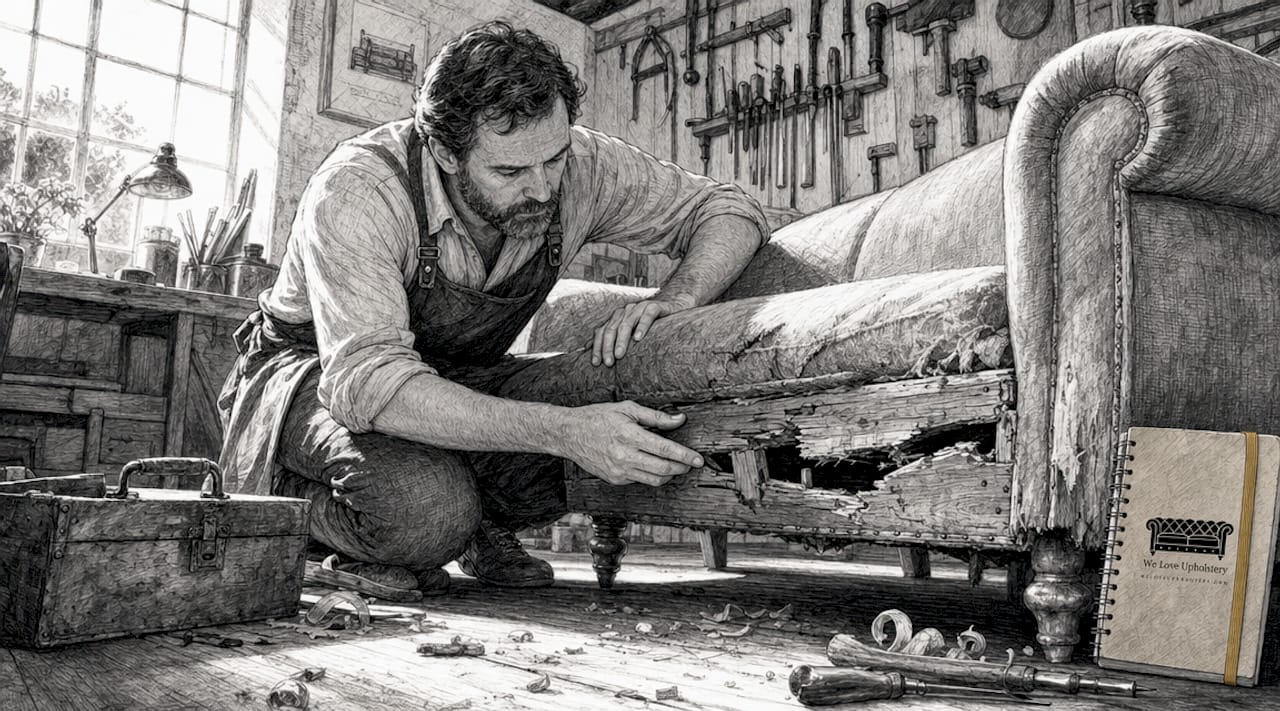
The frame test is the first thing any professional upholsterer does, and you can do it yourself in under five minutes. Sit on the arms of the sofa and apply your full body weight. A quality frame will hold firm. A failing frame will flex, creak, or shift noticeably. That flex means the wood is compromised, and reupholstering it is throwing money at a problem that will return within a year or two.
Beyond the arm test, check these specific indicators:
- Sagging seat deck: Press down on the seat cushions and feel for the suspension beneath. Broken sinuous springs or blown webbing create a hammock effect that is repairable, but only if the frame itself is sound.
- Corner block joinery: Flip the sofa and look at the underside. Quality frames use corner blocks, which are small triangular wood pieces glued and screwed into each frame joint. Stapled butt joints with no blocks indicate a budget build.
- Frame material: Solid hardwood frames, particularly kiln-dried oak, maple, or beech, are worth repairing. Particle board and medium-density fiberboard (MDF) frames are not. They cannot hold staples or screws reliably after the first round of upholstery.
- Wobble test: Stand behind the sofa and push the back frame side to side. Any lateral movement signals loose or broken joints.
Pro Tip: Run your hand along the inside of the sofa arm where it meets the seat. If you feel sharp edges, broken wood, or hear a cracking sound, the frame has already failed internally, even if it looks fine from the outside.
Solid hardwood and corner block joinery are the marks of a sofa worth repairing. Stapled engineered wood is almost never worth the investment. This single distinction eliminates most of the guesswork in the repair decision.
Couch repair cost analysis: what you will actually pay in 2026
Professional sofa repair ranges from $920 to $2,640 for full reupholstery, with basic upholstery repairs running $350 to $1,500 depending on scope. Labor accounts for roughly 55 to 60% of the total project cost, with upholsterers charging $40 to $100 per hour. That means on a $1,800 reupholstery job, you are paying approximately $1,000 in labor alone before a single yard of fabric is cut.
Here is a realistic cost breakdown for common repair scenarios in 2026:
| Repair Type | Estimated Cost | Notes |
|---|---|---|
| Basic fabric repair or patching | $150 to $400 | Cosmetic only; does not address structure |
| Cushion foam replacement | $200 to $600 | Worthwhile if frame is solid |
| Full reupholstery (loveseat) | $600 to $1,500 | Labor-intensive; fabric adds $300 to $600 |
| Full reupholstery (sofa) | $920 to $2,640 | Only justified on quality frames |
| Frame repair or reinforcement | $200 to $500 | Add-on cost if joinery is failing |
The 50% Rule applies directly to this table. If a comparable new sofa costs $1,800 and your repair estimate is $1,100, you are at 61% of replacement cost. Repair costs exceeding 50% of a new comparable unit price signal that replacement is the better financial decision, unless sentimental value tips the scale.
What most homeowners miss is the hidden cost on the replacement side. Disposal fees run $50 to $200, and new sofa delivery and setup adds another $200 to $500 to the sticker price. A sofa listed at $1,200 can realistically cost $1,700 to $1,900 by the time it is in your living room. That changes the math on repair more than most people expect.
Pro Tip: Get at least three written estimates from local upholstery shops before committing. Prices vary significantly by region and shop overhead, and a written quote protects you from scope creep once the work begins.
When is reupholstering worthwhile versus buying new?
Reupholstery makes financial and practical sense in a narrow but important set of circumstances. A solid frame sofa that is reupholstered can last an additional 15 to 25 years. A budget replacement sofa typically lasts 5 to 8 years. That lifespan gap is the core argument for reupholstering quality furniture.
The scenarios where reupholstery is clearly worthwhile:
- The sofa has a solid hardwood frame with intact joinery and passes the arm flex test.
- The piece is a recognized quality brand or custom build that would cost $3,000 or more to replace at equivalent quality.
- You have sentimental attachment or the piece has genuine antique or heirloom value.
- The repair cost falls below 50% of a comparable replacement, including delivery and disposal.
The scenarios where buying new wins:
- Mass-market sofas under $1,500 that are older than 10 years almost never justify reupholstery. The frames are typically particle board or stapled pine, and the labor cost alone will exceed the sofa’s remaining value.
- The sofa’s shape or size no longer fits your space or lifestyle. Reupholstery cannot change key dimensions or silhouette. If you need a sectional and you have a loveseat, no upholsterer can bridge that gap.
- The internal damage is extensive, including broken springs, collapsed webbing, and cracked frame joints all at once. Repairing all three simultaneously pushes costs into replacement territory fast.
One counterintuitive point worth knowing: a new sofa may be cheaper upfront but often uses lighter frames and inferior materials compared to a well-built older sofa. The $900 sofa at a big-box retailer is not the same quality as the $900 repair on a 20-year-old hardwood frame piece. Comparing sticker prices without accounting for material quality is one of the most common mistakes homeowners make.
Practical questions to ask before committing to repair or replacement
Before you call an upholsterer or visit a furniture store, work through this decision checklist. Each question eliminates one category of uncertainty.
- Is the frame solid and stable? Run the arm flex test and the wobble test. If the frame fails either, stop here. Replacement is the answer.
- Do you want to keep the shape and size? If the sofa’s dimensions no longer work for your space, repair is a cosmetic fix on a functional mismatch.
- Does the repair cost fall below 50% of a comparable replacement? Get written estimates and include delivery and disposal in your replacement cost calculation.
- Is there sentimental, heirloom, or design value? A piece with genuine personal or monetary value justifies exceeding the 50% threshold.
- What is the expected lifespan after repair? A quality frame repair adds 15 to 25 years. A budget frame repair adds 2 to 4 years at best.
- How long can you wait? Professional reupholstery typically takes 2 to 6 weeks. If you need a sofa immediately, a new purchase is the practical choice regardless of cost.
Pro Tip: Ask the upholsterer directly whether they would repair this sofa if it were theirs. Honest professional assessments prevent poor investments, and reputable shops will walk away from jobs they know are not worth the customer’s money.
For a deeper look at how furniture quality affects repair value, the furniture repair value guide at Weloveupholstery covers the full evaluation framework in practical detail.
Key takeaways
Couch repair is not worth it when the frame is structurally unsound, the repair cost exceeds 50% of a comparable replacement, or the sofa is a mass-market piece older than 10 years.
| Point | Details |
|---|---|
| Apply the 50% Rule | If repair costs exceed half the price of a comparable new sofa, replacement is the better financial decision. |
| Test the frame first | Sit on the arms and push the back laterally. Any flex or wobble means the frame has failed and repair is not justified. |
| Account for hidden costs | Add disposal fees ($50 to $200) and delivery ($200 to $500) to the replacement cost before comparing with repair estimates. |
| Quality frames justify repair | Solid hardwood sofas reupholstered correctly can last 15 to 25 additional years, far exceeding budget replacements. |
| Mass-market sofas rarely qualify | Sofas under $1,500 with particle board frames and more than 10 years of use are almost never cost-effective to reupholster. |
What I’ve learned from watching homeowners make this decision
Most homeowners I’ve worked with make the same mistake: they fall in love with a fabric swatch before they have checked whether the frame deserves it. I’ve seen people spend $1,400 reupholstering a sofa with a particle board frame that started creaking again within 18 months. The fabric looked beautiful. The bones were already gone.
The honest truth about couch repair versus replacement is that the decision is almost never about the fabric. It is always about the frame. Once you accept that, the rest of the analysis becomes straightforward. A solid hardwood frame with intact joinery is an asset worth protecting. A stapled pine frame from a fast-furniture retailer is not.
I also think the sustainability argument for repairing quality furniture is underrated. Keeping a well-built sofa in service for another 20 years is genuinely better for the environment than sending it to a landfill and buying a replacement that will last 6 years. That matters, and it should factor into the decision alongside the cost math.
My practical advice: get a professional estimate before you decide anything. Reputable upholsterers will tell you honestly when a piece is not worth repairing. That free assessment is worth more than any online calculator.
— Dustin
Ready to make the right call on your couch?
If you have run through the frame tests and cost comparisons and you are still unsure, Weloveupholstery has the resources to help you move forward with confidence.

Start with the repair value guide to understand exactly what makes a piece worth restoring. If you are leaning toward reupholstery, the upholstery fabric guide walks you through material selection, durability ratings, and cost per yard so you can budget accurately before committing. For homeowners ready to explore professional options, the full service overview at Weloveupholstery covers what to expect from a professional repair, from initial assessment through final installation.
FAQ
When is couch repair not worth it?
Couch repair is not worth it when the frame is structurally compromised, the repair estimate exceeds 50% of a comparable new sofa’s cost, or the piece is a mass-market sofa under $1,500 that is older than 10 years. These three conditions, individually or combined, signal that replacement delivers better long-term value.
How much does professional sofa reupholstery cost in 2026?
Professional sofa reupholstery ranges from $920 to $2,640, with labor accounting for 55 to 60% of the total. Basic repairs like cushion replacement or fabric patching run $150 to $600 depending on scope and materials.
What is the 50% Rule for furniture repair?
The 50% Rule states that repair is not financially justified if the restoration cost exceeds half the price of a comparable new piece. This industry benchmark applies to sofas, chairs, and most upholstered furniture, with exceptions for heirloom or high-value antique pieces.
Can reupholstery change the size or shape of my sofa?
No. Reupholstery cannot change key sofa dimensions or silhouette. If your sofa no longer fits your space or lifestyle needs, replacement or a custom build is the only option that addresses the geometry problem.
How long does a reupholstered sofa last?
A quality hardwood frame sofa that is professionally reupholstered can last an additional 15 to 25 years. Budget sofas with particle board frames typically last only 2 to 4 years after repair, making the investment difficult to justify on cost alone.