Heads up: this post contains affiliate links. If you buy through them, We Love Upholstery may earn a small commission at no extra cost to you.
Accurately measuring fabric for sofa upholstery means calculating each individual panel, not just the sofa’s overall dimensions. Most DIY reupholstery projects fail at the fabric stage because homeowners treat the sofa as one big box and end up short or wasteful. Standard upholstery fabric runs 54 inches wide, which directly controls how many linear yards you need to order. Get the panel measurements right first, and the rest of the project falls into place.
What tools do you need before measuring sofa fabric?
The right setup before you start saves you from remeasuring twice. You need a flexible measuring tape (cloth or fiberglass, not a rigid metal one), a pencil, graph paper or a notepad, and a basic calculator. A smartphone works fine for the math, but sketching each panel on paper forces you to think systematically about the sofa’s structure.
Beyond tools, you need two pieces of information about your fabric before you touch the sofa. First, confirm the fabric width. Upholstery fabric is typically 54 inches wide, though decorator fabrics sometimes run 60 inches and budget options can be as narrow as 45 inches. Second, check the pattern repeat. A solid or textured fabric has no repeat, so you cut freely. A large floral or geometric print may have a vertical repeat of 12 to 27 inches, which forces you to buy extra yardage for alignment.
Knowing your fabric’s orientation also matters before you measure. Fabrics described as “railroaded” run horizontally off the bolt, which can eliminate seams on wide panels and reduce total yardage. Standard “up the roll” fabric runs vertically, which is the default assumption in most yardage calculations. Check the fabric orientation details with your supplier before you finalize any numbers.
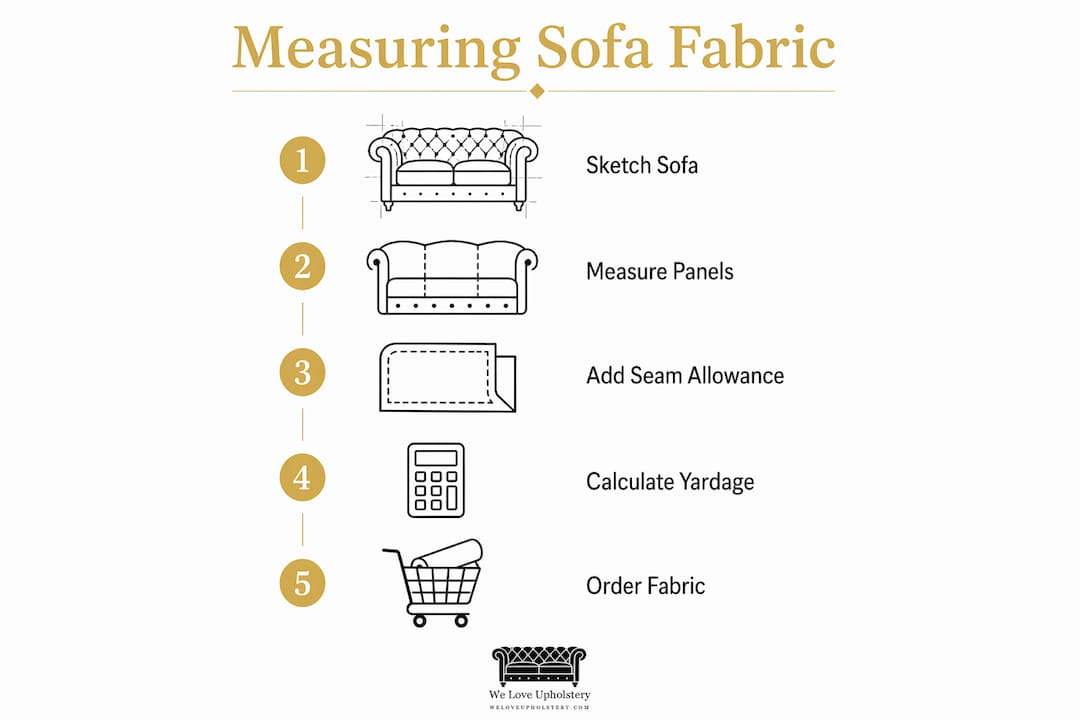
Pro Tip: Sketch a simple diagram of your sofa from the front, side, and top before you measure. Label each panel by name. This sketch becomes your measurement worksheet and prevents you from forgetting a section like the arm fronts or the base boxing strip.
How do you measure each sofa panel accurately?
Professional upholsterers break sofas into cuttable panels rather than measuring the overall frame. This approach accounts for fabric grain, pattern alignment, and seam placement. Here is the standard panel breakdown for a typical three-cushion sofa, measured in inches:
- Inside back. Measure the height from the seat deck to the top of the back, and the width from arm to arm. Add 0.5 inch per edge for seam allowance, so a panel measuring 28 inches tall by 60 inches wide becomes 29 inches by 61 inches on your worksheet.
- Outside back. Measure the full height and width of the back exterior. This panel is often slightly narrower than the inside back because the arms wrap around it.
- Inside arms (two panels). Measure each arm from the seat deck up and over the arm roll to the outside edge. Width runs front to back. Measure both arms separately since sofas are rarely perfectly symmetrical.
- Outside arms (two panels). Measure the exterior face of each arm from the bottom rail to the top of the arm.
- Arm fronts (two panels). These small panels cap the front of each arm. They are easy to forget and often cost you a yard of fabric if overlooked.
- Seat cushions. Measure the top, bottom, and boxing strip (the side band) of each cushion individually. A standard T-cushion has a more complex shape, so trace it on paper if needed. The T-cushion sofa reupholstery guide at Weloveupholstery covers this in detail.
- Seat deck. Measure the flat platform under the cushions. This is often done in a less expensive lining fabric, but measure it anyway.
- Skirt or base panels. If your sofa has a skirt, measure its full perimeter length and drop height. Add 1 inch for hem allowance at the bottom.
Seam allowances of 0.5 inch per edge are the industry standard. That means a panel with four edges gets 1 inch added to both its length and width. Record every panel measurement with allowances already included so you do not have to recalculate later.
Pro Tip: Measure each panel twice before writing it down. Sofa cushions in particular vary in size across the same sofa, especially on older pieces where foam has compressed unevenly. Never assume all three seat cushions are identical.
How to calculate total fabric yardage from your measurements
Once every panel is measured and recorded in inches, the calculation follows a straightforward process. Add up the total square inches of all panels combined. Then divide by the fabric width in inches (use 54 as your baseline) to get the number of linear inches of fabric needed. Divide that figure by 36 to convert to yards.
Here is the formula written plainly: (Sum of all panel widths in inches) divided by 54, then divided by 36, equals base yards needed. From that base number, add a 10 to 20 percent buffer for seams, cutting errors, and pattern matching. A 15 percent buffer is the standard choice for solid fabrics. Use 20 percent for any fabric with a pattern repeat larger than 6 inches.
The table below shows typical yardage ranges by sofa type, assuming 54-inch-wide fabric with no pattern repeat:
| Sofa type | Estimated yardage |
|---|---|
| Loveseat (2-seater) | 8 to 12 yards |
| Standard sofa (3-seater) | 14 to 18 yards |
| Large sectional | 16 to 22 yards |
| Sofa with skirt | Add 2 to 4 yards to base estimate |
| Patterned fabric (large repeat) | Add 15 to 25 percent to base estimate |
These ranges assume a standard sofa without tufting or complex curves. A sofa with a skirted base or large pattern repeat sits at the high end of each range. Pattern repeats and fabric orientation can push a standard three-seater past 20 yards when the repeat exceeds 18 inches.
Pro Tip: Always order fabric in one continuous cut from the same dye lot. Fabric dye lots vary between production runs, and a second order from the same supplier may not match the first roll in color or texture.
What are common measurement mistakes and how to avoid them?
The single most damaging mistake in any sofa fabric measurement guide is treating the sofa as one rectangular box. Measuring the sofa as a whole leads directly to fabric shortages because it ignores the three-dimensional nature of each panel and the waste created by cutting around curves and seams.
Other mistakes that consistently cause problems include:
- Skipping seam allowances. Underestimating seam allowances is one of the most cited causes of fabric shortages in DIY projects. Every cut edge needs that 0.5-inch buffer.
- Ignoring fabric shrinkage. Natural fibers like linen and cotton can shrink 3 to 5 percent after the first cleaning. Add extra yardage if you plan to pre-wash your fabric before cutting.
- Forgetting hidden panels. Welt cording, boxing strips, and skirt linings all consume fabric. Hidden features like welt strips can add a full yard to your total without appearing in any panel measurement.
- Assuming cushions are uniform. Measure every cushion individually. Back cushions are almost always a different size than seat cushions.
- Not verifying fabric width before ordering. A fabric listed as 54 inches wide may actually measure 52 inches after selvage removal. Confirm the usable width with your supplier.
Double-check every measurement against your sketch before placing a fabric order. A five-minute review catches the errors that cost you $50 in wasted fabric.
How do complex sofa features affect fabric yardage?
Some sofas require significantly more fabric than the panel calculation suggests, and the reasons are structural rather than mathematical. Tufting, buttons, and channel work pull fabric inward, which means the flat panel measurement understates the actual fabric consumed. A tufted back panel that measures 28 by 60 inches flat may require a cut piece of 32 by 66 inches to account for the fabric drawn into each button point.
Rounded or barrel arms present a similar challenge. A curved arm cannot be covered with a flat rectangular panel without gathering or pleating, both of which consume extra fabric. The curved sofa back reupholstery guide at Weloveupholstery walks through how to measure and cut for curved surfaces specifically.
Skirted sofas add another layer of complexity. The skirt runs the full perimeter of the sofa base, which on a standard three-seater can exceed 180 inches of linear fabric. A 16-inch drop skirt with a 1-inch hem and a 0.5-inch seam at the top consumes 17.5 inches of fabric width per panel. That adds up fast across a full perimeter.
Large pattern repeats demand the most planning of any fabric variable. You must center the dominant motif on each panel and align the repeat across adjacent panels. This alignment process creates offcuts that cannot be reused, which is why large-repeat fabrics routinely require 20 to 25 percent more yardage than the base calculation produces.
Key takeaways
Accurate sofa fabric measurement requires a panel-by-panel approach, a 10 to 20 percent yardage buffer, and knowledge of your fabric’s width and pattern repeat before you order a single yard.
| Point | Details |
|---|---|
| Panel-based measuring | Break the sofa into individual panels and measure each one separately with seam allowances included. |
| Standard fabric width | Base all yardage calculations on 54-inch-wide fabric and confirm usable width with your supplier. |
| Yardage buffer | Add 10 to 20 percent to your base calculation to cover seams, errors, and pattern matching. |
| Complex features add yardage | Tufting, skirts, and large pattern repeats each require additional fabric beyond basic panel totals. |
| Measure twice, order once | Verify every panel measurement before ordering, and buy from a single dye lot in one continuous cut. |
Why I stopped guessing and started sketching
The first sofa I reupholstered, I measured the overall frame, multiplied length by height, and ordered what I thought was plenty of fabric. I came up three yards short on the outside back and had to source a second cut from a different dye lot. The color mismatch was subtle but visible in natural light, and it bothered me every time I walked past that sofa.
What changed my process was treating the sofa like a pattern-making exercise rather than a math problem. I started sketching every panel on graph paper before touching the measuring tape. That sketch forces you to think about every surface the fabric has to cover, including the ones you cannot see when the sofa is assembled. Arm fronts, base boxing, welt strips: they all show up on the sketch before they disappear from your memory.
The other shift was taking pattern repeats seriously from the start. Most DIYers add a vague “extra yard just in case” for patterned fabric. The right approach is to measure the repeat, count how many times it appears across the inside back panel, and calculate the offset needed for each adjacent panel. It takes ten minutes and saves you from buying fabric that does not align at the seams.
My honest recommendation: do not start measuring until you have your fabric selected. The width and repeat of your chosen fabric change the entire calculation. Measuring first and shopping second is the most common sequencing mistake I see from homeowners starting their first upholstery project.
— Dustin
Ready to go deeper on fabric selection and project planning?
If you have your measurements in hand and need to choose the right fabric for the job, Weloveupholstery has the resources to take you from yardage estimate to finished sofa. The upholstery fabric guide covers fabric types, durability ratings, and how different materials behave under tension and at seams.

For homeowners tackling a full reupholstery project, the T-cushion sofa DIY guide walks through every stage from stripping the old fabric to finishing the final seam. Weloveupholstery is built specifically for DIY homeowners who want professional results without the guesswork. Every guide is written by practitioners who have made the mistakes so you do not have to.
FAQ
How much fabric do I need for a standard 3-seater sofa?
A standard three-seater sofa requires 14 to 18 yards of 54-inch-wide fabric with no pattern repeat. Add 15 to 20 percent for patterned fabrics or sofas with skirts or tufting.
What is the correct seam allowance for sofa upholstery?
The standard seam allowance is 0.5 inch per cut edge. Add 1 inch total to both the length and width of each panel to account for seams on all four sides.
Does fabric orientation affect how much I need to buy?
Yes. Railroaded fabric runs horizontally off the bolt and can eliminate seams on wide panels, reducing total yardage. Standard up-the-roll fabric is the default for most calculations and typically requires more linear yards for the same sofa.
Why should I measure panels instead of the whole sofa?
Measuring the sofa as one unit ignores the three-dimensional cuts, seam allowances, and pattern alignment required for each surface. Panel-based measuring is the method professional upholsterers use because it accounts for every piece of fabric the project actually consumes.
How do I account for a large pattern repeat in my fabric calculation?
Add 15 to 25 percent to your base yardage estimate for any pattern with a repeat larger than 6 inches. Measure the repeat length on the fabric bolt and plan which panel will carry the centered motif before you cut anything.