Heads up: this post contains affiliate links. If you buy through them, We Love Upholstery may earn a small commission at no extra cost to you.
Contract grade upholstery is defined as fabric engineered to meet specific, measurable performance criteria for abrasion resistance, fire safety, and cleanability in high-traffic commercial environments. The term “contract grade” is an industry designation, not a legal category, meaning the distinction lies in the performance specification rather than who owns the building or furniture. Key benchmarks include the Martindale rub test, California TB 117-2013 fire certification, and cleaning code compliance. Understanding what is contract grade upholstery matters whether you are specifying seating for a hotel lobby or simply want furniture that survives a busy household for a decade or more.
What key performance standards define contract grade upholstery?
Contract grade upholstery is defined by a set of performance criteria covering abrasion resistance, fire certification, cleaning stability, and dimensional integrity. No single number tells the whole story, but abrasion resistance is the most cited starting point.
Abrasion resistance: Martindale vs. Wyzenbeek
Contract grade fabric typically achieves 40,000 Martindale rubs or more, compared to heavy domestic fabrics that fall in the 25,000 to 40,000 range. Some fabrics engineered for very heavy commercial use reach 80,000 to over 200,000 rubs. That gap is significant. A hotel chair seat absorbs far more friction per day than a living room sofa, and the fabric must reflect that reality.

The Martindale test (ISO 12947) and the Wyzenbeek test (ASTM D4157) are not directly interchangeable. US and UK thresholds differ by method, so a raw rub count without specifying which test was used is not a reliable specification. Always confirm which standard applies before accepting a supplier’s claim.
Pro Tip: When reviewing a fabric spec sheet, look for both the test method name and the threshold number. “100,000 rubs” means nothing without knowing whether it was Martindale or Wyzenbeek.
Fire safety standards
Fire certification is the second pillar of contract grade fabric. The most common standards are California TB 117-2013 (smolder resistance for filling materials), California TB 133 (full-scale ignition for public seating), NFPA 701 (textiles and films), and BS 5852 Crib 5 for UK and EU projects. Inherent FR fabrics like Trevira CS maintain permanent flame resistance because the fire-resistant property is built into the fiber itself. Topically treated fabrics can lose efficacy after repeated cleaning cycles, which matters in any environment where upholstery is laundered or wiped down regularly.
Other performance criteria
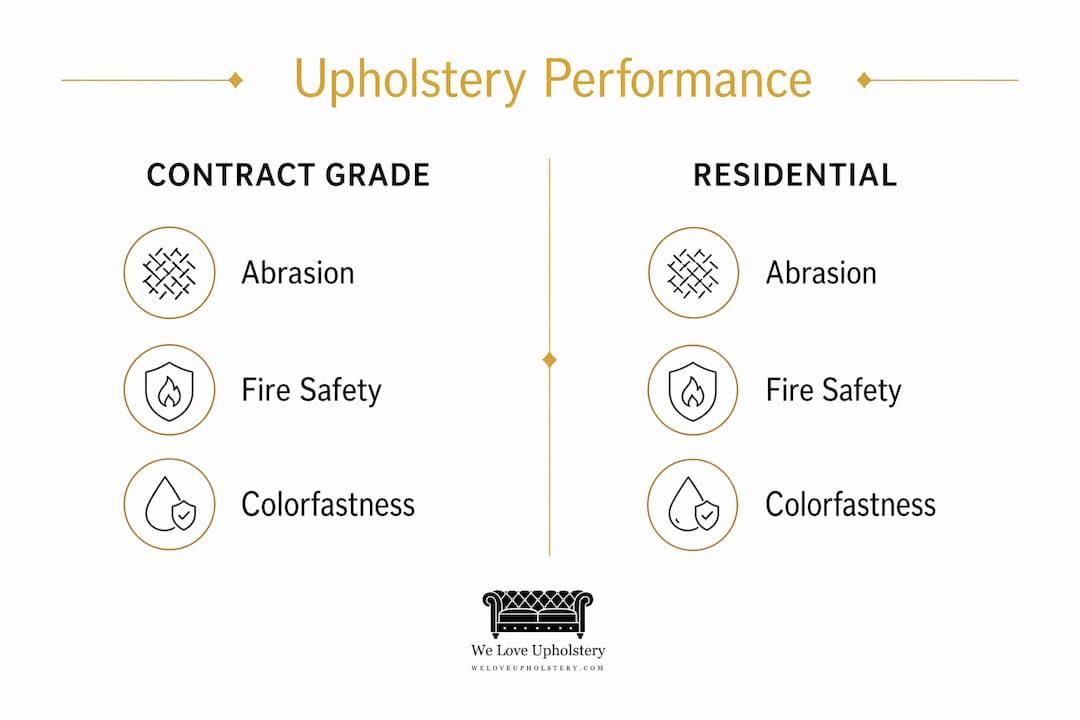
Beyond abrasion and fire, contract grade fabric specifications include colorfastness to light and rubbing (crocking), pilling resistance, dimensional stability after cleaning, and cleaning code compatibility. A fabric rated W (water-based cleaning) must genuinely tolerate repeated wet cleaning without shrinking or color bleed. These criteria collectively define whether a fabric performs as a system, not just as a surface.
| Performance Criterion | Contract Grade Threshold | Residential Threshold |
|---|---|---|
| Abrasion resistance (Martindale) | 40,000+ rubs | 15,000 to 25,000 rubs |
| Fire certification | TB 117-2013, TB 133, BS 5852 Crib 5 | TB 117-2013 (California only) |
| Colorfastness (crocking) | Grade 4 or higher | Grade 3 acceptable |
| Cleaning compatibility | Verified by cleaning code | Often unverified |
How does contract grade upholstery differ from residential upholstery?
The contract upholstery definition is performance-based, not ownership-based. A fabric sold as “commercial grade” without a test certificate and a named threshold is a marketing term, not an engineering specification. Marketing claims like “commercial grade” without method or verification are not engineering proof. That distinction protects you from paying a premium for fabric that underperforms.
The practical differences between contract and residential upholstery break down across several dimensions:
- Abrasion resistance: Residential fabrics are typically rated for 15,000 to 25,000 Martindale rubs. Contract fabrics start at 40,000 and go significantly higher for heavy commercial use.
- Fire standards: California TB 117-2013 applies broadly, but TB 133 and BS 5852 Crib 5 are legally required only in commercial or rental properties. A homeowner is not legally obligated to meet TB 133, but a hotel operator is.
- Cleaning requirements: Commercial environments demand fabrics that tolerate frequent, aggressive cleaning with disinfectants. Residential fabrics are rarely tested to that standard.
- Colorfastness and crocking: Contract specifications require higher grades because color transfer onto clothing or adjacent surfaces creates liability in public spaces.
- Cost and total ownership: Contract grade fabric costs more upfront. Over a 10-year lifespan in a high-use setting, the cost per year of service is typically lower than replacing residential fabric every three to four years.
Contract specifications are appropriate for residential settings with heavy use, pets, children, or a longevity requirement of 10 or more years. A rental property owner, for example, faces cleaning and wear demands that closely resemble commercial use. Specifying contract grade fabric in that context is a practical investment, not an overspecification.
The fire regulation nuance is worth emphasizing. In commercial settings, meeting fire standards is a legal requirement tied to building codes and occupancy classifications. In a private home, it is a choice. That said, choosing inherently FR fabric for a home theater or a vacation rental is a reasonable safety decision regardless of legal obligation.
What practical factors should you consider when specifying contract grade upholstery?
Selecting contract grade fabric requires looking beyond the headline rub count. High abrasion ratings alone do not guarantee upholstery longevity. Seam durability, pilling, crocking, and composite material behavior are all critical to real-life performance. A fabric with 150,000 Martindale rubs that pills aggressively after six months of use will look worn and cheap regardless of its test score.
Follow this process when specifying or purchasing contract grade upholstery:
- Define the use case first. Identify traffic volume, cleaning frequency, exposure to sunlight, and the type of contact (seated use, armrest friction, or back contact). Each factor shifts which performance criteria matter most.
- Request test certificates, not just spec sheets. Test certificates from accredited labs confirm the exact specimen tested, the method used, and the threshold achieved. A spec sheet without a certificate is a starting point, not proof.
- Match cleaning codes to your maintenance program. A fabric coded S (solvent-based cleaning only) is unsuitable for a healthcare environment that uses water-based disinfectants. Confirm cleaning code compatibility before specifying.
- Evaluate seam performance separately. Seam strength and seam slippage tests (ASTM D4034 or BS EN ISO 13935) tell you whether the fabric will hold at stress points. Failures often occur at seams or due to color transfer despite high rub counts.
- Check the foam and frame interface. Contract grade performance depends on the underlying frame and foam quality, not just the fabric. A high-spec fabric on a weak frame will fail prematurely.
Pro Tip: Ask your supplier for a sample swatch and test it with your actual cleaning product before committing to a large order. Colorfastness to specific disinfectants is rarely included in standard test certificates.
Maintenance also extends fabric life significantly. Rotating cushions, vacuuming regularly to remove abrasive particles, and addressing spills immediately all reduce wear. For upholstery supply materials that support durability, choosing the right backing, foam density, and thread type matters as much as the face fabric.
What regulations govern contract grade upholstery in commercial settings?
Furniture procurement in commercial environments bundles multiple compliance dimensions: durability, fire safety, emissions, and labeling. The regulatory framework varies by geography and occupancy type, but the core standards are consistent across most commercial projects.
| Standard | Region | Scope |
|---|---|---|
| California TB 117-2013 | United States | Smolder resistance for upholstered furniture filling |
| California TB 133 | United States | Full-scale ignition test for public seating |
| NFPA 701 | United States | Flame propagation for textiles and films |
| BS 5852 Crib 5 | UK and EU | Ignition resistance for contract seating |
| BIFMA e3 | United States | Emissions and sustainability criteria for office furniture |
California TB 117-2013 replaced the older TB 117 standard and removed the requirement for chemical flame retardants in filling materials. This shift favored inherently FR face fabrics because the smolder resistance now comes from the fabric layer rather than chemical treatment in the foam. California SB 1019 requires labeling that discloses whether flame retardants were used, giving buyers transparency at the point of purchase.
The EPA’s Office/Furniture Model Contract Language requires TB 117-2013 compliance along with flame retardant labeling and emissions standards for federally procured furniture. BIFMA e3 criteria add a sustainability layer covering VOC emissions and material sourcing. For designers specifying furniture for federal buildings, LEED-certified spaces, or healthcare facilities, bundled documentation covering all three dimensions is the standard expectation.
Inherent FR fabrics are the preferred specification for most contract environments because their flame resistance does not degrade with cleaning. Topical treatments, while initially effective, require re-treatment after a defined number of wash cycles. In a hotel or healthcare setting where upholstery is cleaned weekly, that maintenance burden is both costly and easy to overlook.
Key takeaways
Contract grade upholstery is a performance specification system requiring verified abrasion resistance, fire certification, and cleaning compatibility, not simply a label applied to commercial furniture.
| Point | Details |
|---|---|
| Performance over marketing | Demand test certificates with named methods and thresholds, not just “commercial grade” claims. |
| Abrasion resistance baseline | Contract grade fabric starts at 40,000 Martindale rubs; heavy commercial use often requires 80,000 or more. |
| Fire standards vary by use | TB 117-2013 applies broadly; TB 133 and BS 5852 Crib 5 are legally required in commercial occupancies. |
| Seams and system integrity | High rub counts mean little if seam strength, foam quality, and cleaning compatibility are not also verified. |
| Residential applications exist | Households with pets, children, or rental use benefit from contract specifications even without a legal obligation. |
Why contract grade is a performance system, not a product category
I have seen designers spec a fabric with a 200,000 Martindale rating and then watch it fail within 18 months. The fabric was fine. The seams were not. The foam was too soft for the seat depth. The cleaning staff used a bleach solution that was not compatible with the dye. Every one of those failures was preventable, and none of them showed up in the headline rub count.
The biggest misconception I encounter is treating contract grade as a binary label. Either a fabric is “contract” or it is not. That framing misses the point entirely. Contract grade is a performance package. A fabric earns that designation by meeting a defined set of criteria for a defined use context. A fabric that passes TB 133 for a hotel lobby does not automatically perform well in a healthcare waiting room that requires daily disinfection with quaternary ammonium compounds.
For homeowners, my honest recommendation is this: if your sofa takes more than moderate daily use, has kids or pets involved, or needs to last more than seven years without reupholstering, look at contract grade fabrics seriously. The price premium is real but so is the difference in longevity. You are not overbuilding. You are buying the right tool for the actual job.
The certification piece also matters more than most buyers realize. I have reviewed spec sheets that listed impressive numbers with no lab name, no test method, and no date. That is not a specification. That is a brochure. Demand the actual certificate. If a supplier cannot produce one, move on.
— Dustin
Explore contract grade upholstery resources at Weloveupholstery

Weloveupholstery provides practical, hands-on guidance for anyone working with upholstery at a professional or DIY level. If you are specifying or restoring furniture to contract grade standards, the details matter at every layer, from fabric selection to seam integrity. The guide on repairing upholstery seams walks through techniques that hold up under real commercial stress. For complex projects, the curved sofa reupholstery guide covers the kind of precision work that contract grade furniture demands. Browse the full range of upholstery services to find the right support for your project.
FAQ
What is the contract upholstery definition in simple terms?
Contract grade upholstery refers to fabric that meets verified performance standards for abrasion resistance, fire safety, and cleanability in commercial or high-use environments. The designation is based on measurable criteria, not on who owns the furniture.
How many Martindale rubs does contract grade fabric require?
Contract grade fabric typically requires 40,000 Martindale rubs or more, with some heavy commercial applications specifying 80,000 to over 200,000 rubs. The threshold depends on the specific use environment and the applicable specification standard.
Can homeowners use contract grade upholstery fabric?
Yes. Contract grade specifications are appropriate for residential settings with heavy use, pets, children, or a need for furniture to last 10 or more years. Fire standard compliance is legally required only in commercial or rental properties, but the durability and cleaning benefits apply in any high-use context.
What is the difference between inherent FR and topically treated FR fabric?
Inherent FR fabrics like Trevira CS have flame resistance built into the fiber, so it does not degrade with cleaning. Topically treated fabrics are coated with a flame retardant finish that can lose effectiveness after repeated wash cycles, making them less reliable for environments with frequent cleaning.
Why is a test certificate more important than a spec sheet?
A spec sheet lists claimed performance values, while a test certificate from an accredited lab confirms the exact fabric tested, the method used, and the result achieved. Without a certificate, a “commercial grade” claim is a marketing statement, not verified engineering data.