Heads up: this post contains affiliate links. If you buy through them, We Love Upholstery may earn a small commission at no extra cost to you.
Vintage upholstery is defined as a set of hand-crafted construction methods using natural materials, specific layering sequences, and traditional spring systems to preserve the comfort, profile, and character of antique furniture. The examples of vintage upholstery techniques covered here span hand-tied coil springs, staged stuffing with horsehair and straw, tensioned jute webbing, and period-specific finishing details like tufting and gimp trim. These are not decorative choices. They are structural decisions that determine whether a restored piece holds its shape for another century or fails within a decade. If you are restoring a Victorian parlor chair, a mid-century settee, or any antique piece worth saving, understanding these methods is the difference between authentic restoration and expensive guesswork.
1. Examples of vintage upholstery techniques: hand-tied spring systems
Hand-tied springs are the defining structural feature of traditional upholstery methods, and they remain the gold standard for seat resilience in antique furniture. Traditional seat systems use jute webbing as the spring base, with twine controlling spring tops, perimeter edge work, and layered stuffing to create the seat crown and profile. The springs sit on a grid of interlaced jute webbing strips, each tensioned and tacked to the frame before any spring is placed.
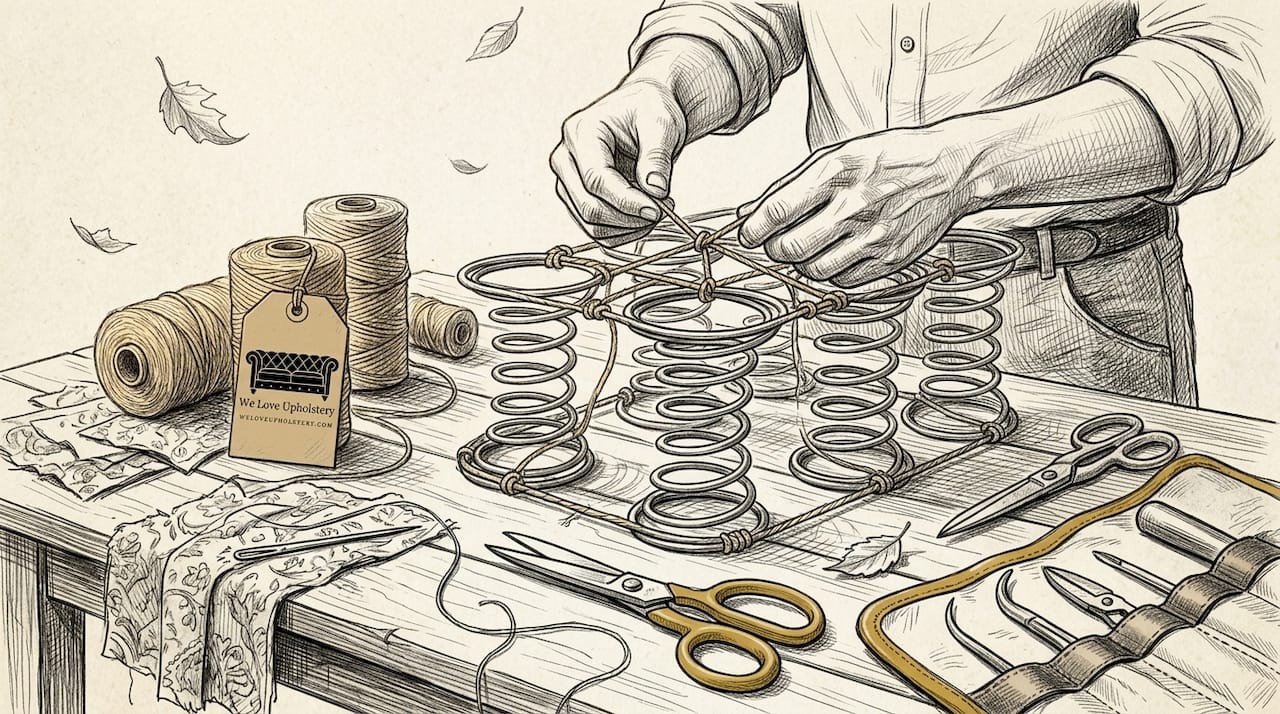
The knot pattern you use matters more than most beginners expect. The 8-knot tying pattern, which includes diagonal ties across the spring tops, provides better support and longevity than simpler 4-knot systems. Each spring is tied front-to-back, side-to-side, and diagonally, locking the spring in place and distributing weight evenly across the seat.
Key steps in hand-tied spring construction:
- Interlace jute webbing strips at 2-inch intervals across the frame base, tacking each end with three or more tacks
- Position coil springs upright on the webbing intersections, stitching the base coil to the webbing with a curved needle
- Tie each spring top with laid cord using the 8-knot pattern, starting from the back rail and working forward
- Finish with a burlap layer stitched over the spring tops to contain the stuffing above
Pro Tip: Before cutting any old twine, photograph the spring layout from above. The original tying geometry tells you the intended seat profile and helps you replicate it exactly.
2. Layered stuffing: the staged approach of traditional upholstery
Stuffing layers control the final comfort and profile of a seat more than the fabric does. Traditional upholstery involves two stuffing stages: first stuffing builds the body and initial profile, while second stuffing refines the surface and prepares it for the final fabric covering.
The first stuffing stage uses coarser, bulkier materials:
- Straw or Spanish moss forms the base mass, packed firmly over the burlap spring cover to build height and edge definition
- Curled horsehair goes over the moss layer, adding resilience and preventing the seat from compressing flat under weight
- A stitched edge roll is formed at the perimeter to hold the stuffing in place and define the seat’s visual profile
The second stuffing stage uses finer materials to smooth the surface. A thin layer of curled horsehair or cotton batting is laid over the first stuffing and covered with a muslin undercover, which is pulled taut and tacked to the frame. This muslin layer is what you actually fit and adjust before committing to the final fabric.
Victorian upholstery from the 1870s used straw, Spanish moss, curled horsehair, and wool batting in exactly this sequence to achieve the deep, rounded seat profiles characteristic of that era. Matching this material sequence is what separates a historically accurate restoration from a modern approximation. Fabric choice also drives stuffing decisions. Silk brocade demands firm padding and horsehair, while velvet requires careful padding management to maintain its sheen. The stuffing is not just comfort engineering. It is part of the fabric’s performance system.
3. Traditional support foundations: jute webbing, burlap, and muslin
The foundation layers in vintage upholstery are what make everything above them work. Without properly tensioned webbing and intact containment layers, even perfect stuffing will shift, sag, and lose its shape within months.
Key foundation components and their functions:
- Jute webbing forms the tensioned base grid that carries the spring system. Each strip must be stretched to roughly 10 percent compression before tacking to maintain the correct spring height
- Burlap sits over the spring tops as a containment layer, stitched to each spring coil to prevent lateral movement and provide a stable base for stuffing
- Muslin serves as the final undercover layer, pulled over the second stuffing to lock the shape before the decorative fabric is applied
Original stuffing like straw, moss, and horsehair can be preserved in conservation-sensitive restoration by replacing only the rotten burlap and muslin layers. This approach maintains historical authenticity while restoring structural integrity. You are not rebuilding the piece. You are repairing its containment system.
Retaining original stuffing materials is not just about authenticity. It preserves the physical evidence of how the piece was built, which is irreplaceable once discarded.
Conservation of these layers also means studying the original tack lines, stitch patterns, and webbing spacing before removing anything. Documenting support geometry before teardown is critical to choosing the correct repair approach and preserving period authenticity. A photograph of the underside before you pull a single tack is worth more than any written description.
4. Period-specific finishing details: tufting, edge rolls, and decorative trims
Finishing details are where historical upholstery craftsmanship becomes visible. These are the elements that identify a piece’s era and signal whether a restoration was done with care or cut corners.
Tufting is the most recognizable vintage finishing technique. Tuft knots in vintage upholstery backs were often secured with spring cord rather than cotton plugs to prevent knot pull-through, a technique dating to circa 1850. This detail is easy to miss and easy to get wrong. Using modern cotton plugs on a Victorian piece changes the behavior of the tuft under tension and can cause the fabric to pucker differently than the original.
Other period-specific finishing details include:
- Stitched edge rolls built from stuffing and twine to create firm, defined seat edges on formal Victorian and Edwardian pieces
- Piping and welting sewn from matching or contrasting fabric to define seam lines and protect edges from wear
- Gimp trim and nailhead borders applied over tacked fabric edges to conceal raw edges and add decorative period character
- Fringe and bullion trim used on skirts and base edges of formal sofas and chairs from the 18th and 19th centuries
Pro Tip: Original upholsterers often tufted by eye rather than by measurement, so exact measuring may not replicate the authentic irregularities of a vintage tufted back. Study the original spacing before removing the fabric.
The trim choice is era-specific. Nailhead borders suit Arts and Crafts and Mission-style pieces from the early 20th century. Gimp and fringe belong to Victorian and Edwardian work. Applying the wrong trim to a restored piece is as historically inaccurate as using the wrong fabric.
5. Conserve or replace: comparing vintage and modern upholstery approaches
The central decision in any restoration project is whether to conserve original materials or replace them. The answer depends on condition, not preference.
| Element | Conserve when… | Replace when… |
|---|---|---|
| Jute webbing | Webbing is intact and holds tension | Webbing is rotten, broken, or stretched beyond recovery |
| Coil springs | Springs hold shape and original height | Springs are broken, rusted through, or severely deformed |
| Stuffing (straw, horsehair) | Materials are dry, intact, and free of pests | Stuffing is compacted, infested, or contaminated |
| Burlap and muslin | Fabric is sound and holds stitching | Fabric tears under light tension or shows rot |
| Decorative trim | Trim is original and structurally intact | Trim is missing, damaged beyond repair, or historically incorrect |
Replacement should be based on condition, not nostalgia. Rotten webbing must be re-webbed before retying springs. Springs should be replaced only if structurally compromised, respecting the original spring geometry and height. The goal is to restore function while preserving as much original evidence as possible.
Modern foam and synthetic webbing can replace traditional materials in functional restorations, but they change the feel and profile of the piece. A seat built with 1870s horsehair and coil springs has a different response under weight than one built with modern high-density foam. For pieces where historical accuracy matters, the traditional materials are not optional.
Key takeaways
Authentic vintage upholstery restoration requires matching original materials, spring tying patterns, and stuffing sequences to preserve both the structural integrity and the historical character of the piece.
| Point | Details |
|---|---|
| Hand-tied springs are structural | The 8-knot tying pattern with diagonal ties provides superior seat support and longevity over simpler systems. |
| Stuffing happens in two stages | First stuffing builds body and profile; second stuffing refines the surface before the final fabric is applied. |
| Foundation layers enable everything | Tensioned jute webbing, burlap, and muslin must be sound before any stuffing or fabric work begins. |
| Finishing details are era-specific | Tufting cord, gimp trim, nailheads, and fringe each belong to specific historical periods and must match the piece. |
| Conserve based on condition | Replace only what is structurally compromised; preserve original stuffing and spring geometry wherever possible. |
What I’ve learned restoring vintage pieces the hard way
The biggest mistake I see from restorers at every skill level is treating vintage upholstery as a surface problem. They pull off the fabric, see the stuffing underneath, and assume the real work starts there. It doesn’t. The real work starts at the webbing, and often before that, at the documentation stage.
I’ve torn apart enough Victorian chairs to know that the original upholsterer left a record inside the piece. The tack spacing, the spring layout, the stuffing density at the edges versus the center. All of it tells you what the piece was supposed to feel like. Once you discard that evidence without photographing it, you are guessing. And guessing on a 150-year-old chair is expensive.
The other thing I’d push back on is the instinct to modernize the foundation while keeping the surface traditional. I’ve seen restorers swap out horsehair for foam, re-web with synthetic straps, and then wonder why the finished piece doesn’t sit right under a period fabric. The stuffing layers control the profile. A failed or mismatched foundation cannot be corrected by surface work alone. If you want the piece to look and feel authentic, the foundation has to be authentic too.
Repurposing vintage furniture is deeply satisfying work, but it rewards patience over speed. Document before you cut. Preserve before you replace. And when you do replace, match the original geometry as closely as the condition allows.
— Dustin
Start your restoration with the right guides

Weloveupholstery offers step-by-step tutorials written by practitioners who have worked through exactly the challenges described in this article. Whether you are tackling a curved Victorian sofa back or repairing a failing seam on a period armchair, the guides cover material selection, layering sequences, and period-appropriate finishing in plain language. For restorers working on complex vintage pieces, the curved sofa back guide walks through traditional shaping and tacking techniques in full detail. If seam integrity is your current challenge, the upholstery seam repair guide covers durable fixes that hold up on antique fabrics. You can also explore the full range of restoration materials and methods to source the right supplies for your specific project.
Heres a video of myself upholstering a vintage chair
FAQ
What materials are used in vintage upholstery techniques?
Traditional upholstery methods use jute webbing, coil springs, laid cord, burlap, straw, Spanish moss, curled horsehair, wool batting, and muslin as foundational materials. These natural materials are layered in sequence to build the seat profile, support structure, and surface finish of antique furniture.
How does hand-tied spring tying differ from modern methods?
Hand-tied springs use laid cord knotted to each spring top in multiple directions, with the 8-knot pattern including diagonal ties providing the most stable and durable result. Modern upholstery typically uses sinuous wire springs or foam, which require no tying but produce a different feel and profile than traditional coil systems.
Can original stuffing be preserved during antique fabric restoration?
Yes. Original stuffing materials like horsehair, straw, and moss can be retained by replacing only the deteriorated burlap and muslin containment layers around them. This conservation approach maintains historical authenticity while restoring the structural support that holds the stuffing in place.
What is the purpose of the muslin layer in traditional upholstery?
Muslin serves as the final undercover layer pulled over the second stuffing to lock the seat shape before the decorative fabric is applied. It allows the restorer to fit and adjust the profile without committing to the final fabric, which is especially important when working with expensive period textiles.
How do I know whether to conserve or replace vintage upholstery components?
Replacement decisions should be based on structural condition, not age. Webbing that no longer holds tension, springs that are broken or deformed, and burlap that tears under light pressure should be replaced. Stuffing and springs that are intact and functional should be preserved to maintain the original geometry and feel of the piece.