Spring sofa repair is the process of diagnosing, fixing, and restoring the spring support system inside a sofa to recover proper comfort and structural support. Most sofas use one of three spring systems: sinuous (zig-zag) springs, coil springs, or eight-way hand-tied springs. Each fails differently, and each demands a different repair approach. The good news is that DIY repairs on sinuous springs are viable for most homeowners when damage is limited and the frame is accessible. This guide walks you through every stage, from diagnosis to final reassembly, so you can restore your sofa without replacing it.
How to diagnose spring problems in your sofa
The first step in any spring repair is confirming that springs are actually the problem. Many homeowners spend time and money on cushion replacements when the real issue sits underneath the fabric. Foam cushions compress permanently after roughly four years of daily use, which mimics the feel of spring failure. Before you buy anything, you need to tell the two apart.
Sit on the sofa and press firmly across the seat surface. A cushion problem feels uniformly soft and spongy throughout. A spring problem feels uneven, with specific spots that sink lower than others, or you may feel a hard poke from a spring pushing through the fabric. Audible creaking or a sharp metallic sound when you shift your weight is a strong indicator of spring movement or a broken clip.
Visual cues to look for:
- Visible sagging in one section of the seat, not the whole cushion
- A lump or ridge running across the seat (a displaced sinuous spring)
- A sharp poke felt through the cushion (a broken or detached coil spring)
- Creaking or metallic sounds when sitting or shifting weight
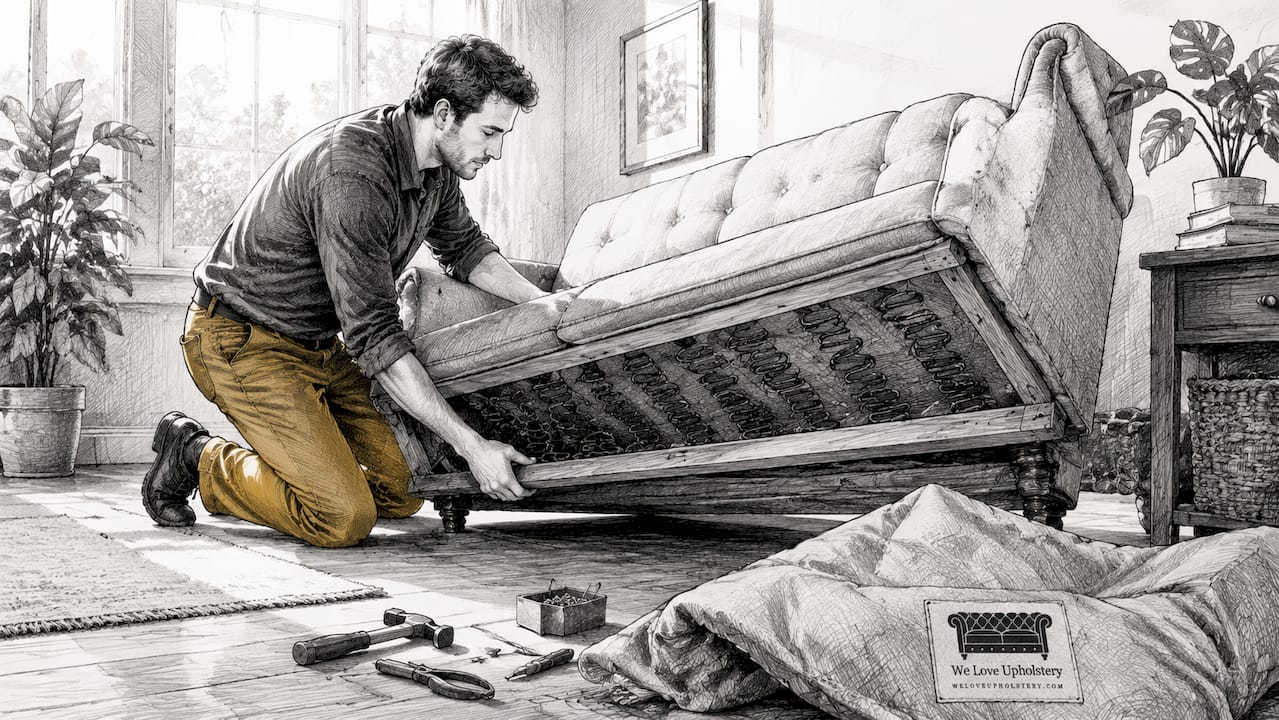
Removing the dust cover fabric underneath the sofa is the only reliable way to inspect the spring deck directly. Use a staple remover or flathead screwdriver to pull the staples along the edges, then fold the fabric back. You will immediately see whether springs are detached, bent, or missing clips. A professional inspection of this kind typically takes 20 to 30 minutes and identifies failures like broken clips or degraded twine. You can do the same at home in a similar timeframe.
Pro Tip: Photograph the spring layout before you touch anything. This reference image will save you significant confusion during reassembly, especially if multiple springs are involved.
Once you have access, identify your spring type. Sinuous springs are S-shaped metal wires running front to back across the frame. Coil springs are barrel-shaped and sit upright on a webbing base. Eight-way hand-tied springs are coil springs connected by twine in eight directions, and they are the most complex system to repair.
What tools and materials you need before starting
Gathering the right supplies before you start prevents mid-repair delays and reduces the risk of improvising with the wrong parts.
Core tools:
- Needle-nose pliers and standard pliers
- Wire cutters
- Staple remover or flathead screwdriver
- Heavy-duty staple gun (with 3/8 inch or 1/2 inch staples)
- Safety glasses (non-negotiable when working with tensioned springs)
- Work gloves
Replacement parts and materials:
- Sinuous spring clips (metal or plastic, matched to your frame type)
- Replacement sinuous or coil springs (measure the originals for gauge and length)
- Jute or nylon spring twine for coil spring systems
- Paper-wrapped wire for edge reinforcement
| Material | Purpose | Where to source |
|---|---|---|
| Sinuous spring clips | Reattach or replace broken frame clips | Upholstery supply stores, online retailers |
| Replacement sinuous springs | Swap out snapped or severely bent springs | Measure originals; buy matched gauge |
| Jute or nylon twine | Retie or reinforce coil spring systems | Upholstery suppliers, fabric stores |
| Heavy-duty staple gun | Reattach dust cover and webbing | Hardware stores |
| Safety glasses | Eye protection from spring tension | Hardware stores |
Matching spring gauge matters more than most DIYers realize. A spring that is too light will compress too easily and fail again within months. A spring that is too stiff will create an uneven seat surface. Measure the wire diameter and the spring height of the original before ordering replacements. For a broader look at upholstery supply materials, Weloveupholstery has a dedicated guide that covers what to buy and why.
Step-by-step guide to repairing sinuous and coil springs
Most residential sofas use sinuous springs, and most sinuous spring failures come down to three issues: a detached spring end, a broken clip, or a bent spring that no longer sits level. Here is how to address each one.
-
Remove the dust cover. Flip the sofa onto its front cushions or lean it against a wall. Use a staple remover to pull the staples along the perimeter of the dust cover fabric. Fold it back carefully and set it aside. You will reattach it at the end.
-
Inspect every spring and clip. Run your hand along each sinuous spring from one side of the frame to the other. Check that both ends are seated in their clips. Look for clips that are bent open, cracked, or missing entirely.
-
Reattach detached springs. If a spring end has popped out of its clip, use pliers to hook it back into position. Always use pliers to hook springs back into frame clips and never put your hands or face into the direct path of the spring’s tension. The stored energy in a sinuous spring is enough to cause a serious injury if it releases suddenly.
-
Replace broken clips. Pry out any cracked or missing clips with a flathead screwdriver. Tap the replacement clip into the frame channel with a hammer until it seats flush. Hook the spring end in and confirm it is secure.
-
Reshape bent springs. If a spring is bowed sideways or has a kink, use both hands and pliers to gently work it back toward its original shape. Replace springs only when they are snapped or significantly deformed. Reshaping and reattachment saves most springs and avoids the cost of replacement parts.
-
Retie or reinforce coil springs. For coil spring systems, check the twine running across the tops of the springs. Cut away any frayed or broken twine. Tie new jute or nylon twine from the front rail to the back rail, pulling each spring to its correct upright position before knotting. Repeat in the perpendicular direction.
-
Test before reassembling. Press firmly across the entire spring deck with your hands before reattaching the dust cover. Every spring should feel even and return to its original height. Sit on the sofa with the dust cover still loose to confirm the repair holds under body weight.
-
Reattach the dust cover. Pull the fabric taut and staple it back along the frame perimeter, spacing staples every two to three inches for a clean, secure finish.
Pro Tip: If you find a spring poking through the cushion fabric, address it immediately. A spring pushing through causes upholstery puncture and dramatically increases repair complexity and cost the longer it is ignored.
When should you call a professional upholsterer?
Eight-way hand-tied spring systems are a different category entirely. These systems use individual coil springs tied in eight directions with jute twine, creating a suspension that conforms precisely to body weight. They appear in high-quality traditional sofas and are the standard for furniture built to last decades. Repairing them incorrectly does not just fail to fix the problem. It can make the sofa worse.
Proper documentation of the original twine pattern, spring layout, and edge roll before disassembly is critical to restore original comfort. If you strip a hand-tied seat without photographing every knot and twine direction, you lose the reference needed to restore it accurately. This is the single most common mistake made by homeowners attempting this repair without guidance.
Signs you need a professional:
- The sofa uses eight-way hand-tied springs and more than one spring or tie has failed
- The jute webbing base under the springs is torn or sagging
- The sofa frame itself is cracked or broken at a joint
- Multiple webbing straps or spring clips have failed across the seat
“In eight-way hand-tied spring systems, adding padding to fix a sag is ineffective if the underlying jute webbing or spring base is compromised. Real restoration requires inspecting and repairing the foundation first.” — Upholstery Handbook
On the cost side, DIY parts run $20 to $60 for most sinuous spring repairs, while professional repairs range from $150 to $900 depending on the extent of the work. For a sofa with a solid frame and quality upholstery, professional repair is almost always worth it compared to replacement. If you are unsure whether your sofa is worth repairing at all, the Weloveupholstery guide on furniture repair value walks through exactly how to make that call.
Key takeaways
Successful spring sofa repair depends on accurate diagnosis, matched replacement parts, and respecting the limits of your spring system’s complexity.
| Point | Details |
|---|---|
| Diagnose before buying parts | Remove the dust cover and inspect springs directly before assuming cushions or frame are the issue. |
| Match spring gauge and length | Replacing springs with the wrong gauge creates uneven support and early re-failure. |
| Safety first with tensioned springs | Always use pliers to hook springs; never place hands in the tension path. |
| Document before disassembly | Photograph spring layout and twine patterns before touching complex systems like eight-way hand-tied. |
| Know when to stop DIY | Multiple clip failures, broken webbing, or a cracked frame signal professional repair or replacement. |
Why I think most people skip the most important step
Most people who attempt spring sofa repair jump straight to the fix. They feel the sag, flip the sofa, see a detached spring, and reattach it. That works sometimes. But in my experience, the detached spring is usually a symptom, not the root cause. The real culprit is often a worn clip channel in the frame, a section of jute webbing that has stretched beyond recovery, or a frame joint that has loosened and shifted the entire spring deck out of alignment.
I have seen homeowners reattach the same spring three times in a year because they never addressed the clip channel underneath it. The fix takes five minutes. The diagnosis takes twenty. Most people invert that ratio and wonder why the problem keeps coming back.
The other mistake I see constantly is over-patching. Someone feels a sag, adds a layer of foam or batting on top of the spring deck, and calls it done. This masks the problem for a few weeks and then makes the eventual repair harder because now there is extra material to remove before you can even see what is wrong. If the foundation is compromised, padding over a sag accomplishes nothing.
My honest advice: spend the first thirty minutes doing nothing but looking. Remove the dust cover, photograph everything, and map out what is actually broken before you pick up a single tool. That thirty minutes of patience will save you hours of rework and, in many cases, the cost of a professional repair call.
— Dustin
Restore your sofa with Weloveupholstery

Weloveupholstery is built for homeowners who want to do this right the first time. Whether you are sourcing the correct spring clips, learning how to retie coil springs, or deciding whether to reupholster after your spring repair, the site offers practitioner-written guides that go beyond surface-level advice. After fixing your springs, the next step is often the fabric. The upholstery fabric guide covers every material type, durability rating, and application so you choose the right cover for your restored sofa. For readers who want hands-on help or professional-grade supplies, explore the full range of repair services and materials available through Weloveupholstery.
FAQ
How do I know if my sofa springs are broken?
Press firmly across the seat and feel for uneven spots, sharp pokes, or a metallic creak when shifting weight. Remove the dust cover underneath to visually confirm detached springs, broken clips, or sagging coil positions.
Can I repair sofa springs myself?
Yes, for sinuous spring systems with limited damage. Reattaching detached springs and replacing broken clips costs $20 to $60 in parts and requires basic tools like pliers and a staple gun.
What is the difference between sinuous and eight-way hand-tied springs?
Sinuous springs are S-shaped wires running across the frame and are the most common and DIY-friendly system. Eight-way hand-tied springs are individual coil springs tied in eight directions with jute twine, found in high-quality traditional sofas and requiring professional skill to repair correctly.
How long does a sofa spring repair last?
A properly executed repair using matched replacement parts and correctly seated clips should last as long as the original spring system, often ten or more years, provided the sofa frame remains structurally sound.
When is it better to replace a sofa than repair the springs?
When multiple webbing straps and spring clips have failed simultaneously, or when the sofa frame is cracked at a joint, repair costs often exceed the sofa’s value. A furniture repair value assessment helps you make that decision objectively.