Heads up: this post contains affiliate links. If you buy through them, We Love Upholstery may earn a small commission at no extra cost to you.
An upholstery tools checklist is a functional grouping of hand tools organized by task, designed to guide beginners through every stage of furniture restoration without guesswork. The right tool list covers five core categories: cutting and layout, removal, forming and placement, holding and tensioning, and measuring and checking. A complete beginner toolkit includes a staple gun, tack hammer, webbing stretcher, fabric shears, upholstery pins, and a tack lifter. Organizing your upholstery project checklist by function, rather than by price or brand, is the single most effective way to avoid costly mistakes on your first project.
1. what belongs on your upholstery tools checklist
Upholstery hand tools are organized into five functional families: cutting and layout, removal, forming and placement, holding and tensioning, and measuring and checking. Each family handles a distinct phase of the project. Skipping a category does not save money. It creates problems in the next phase that cost more time to fix.
The five families work in sequence. You cut and mark first, then remove old material, then shape and form, then fasten and tension, then verify dimensions. Buying tools in this order also makes sense for beginners on a budget. Start with the removal and cutting categories, since those come first in the workflow.
2. cutting and layout tools
Sharp, accurate cutting tools are the foundation of clean upholstery work. Dull blades drag fabric, distort foam, and create uneven seams that compound through every later step.
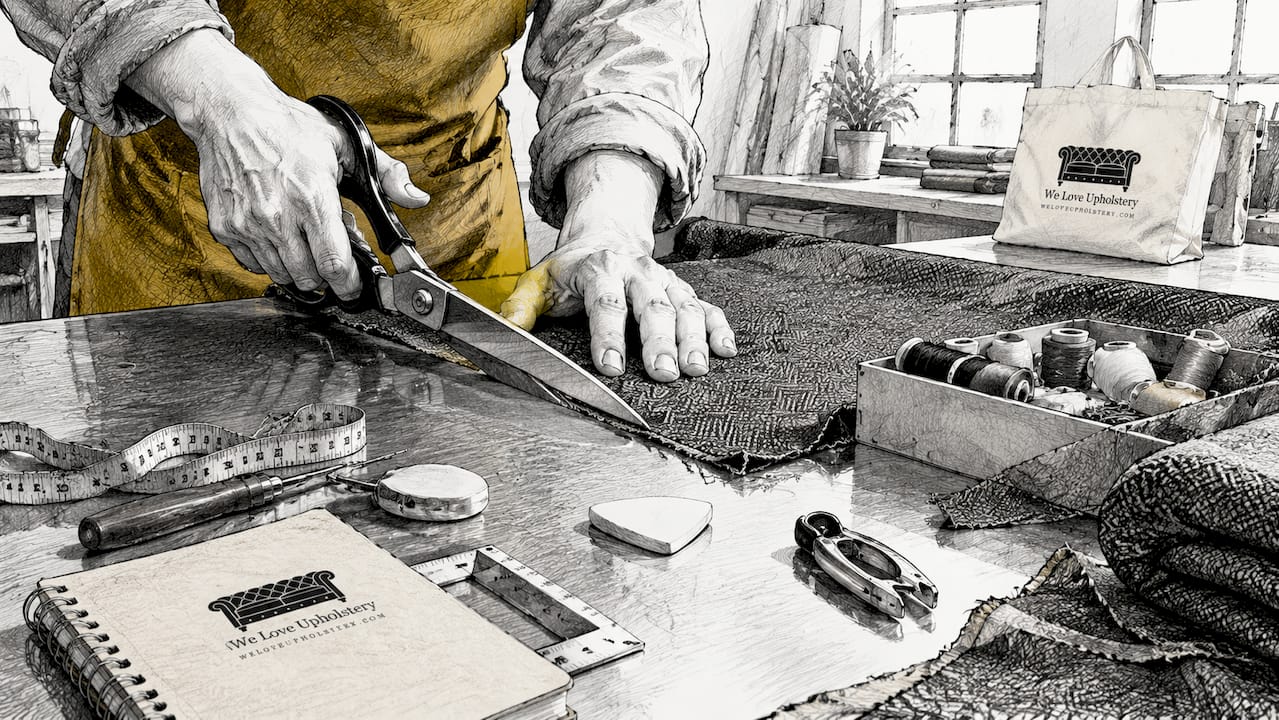
The core cutting and layout kit includes:
- Fabric shears: A dedicated pair of 8–10 inch shears, such as those made by Wiss or Fiskars, reserved exclusively for fabric. Using them on paper or foam dulls the blade fast.
- Utility knife: For scoring and cutting foam, cardboard templates, and webbing. Replace blades frequently.
- Chalk or fabric markers: Tailor’s chalk and water-soluble markers like those from Dritz let you mark cut lines directly on fabric without permanent staining.
- Tape measure and metal ruler: A 25-foot tape measure handles large panels. A 24-inch metal ruler gives you a straight edge for marking and scoring.
- Carpenter’s square: Confirms 90-degree corners on fabric panels before cutting. Misaligned cuts cause pattern drift across an entire piece.
Pro Tip: Keep a dedicated sharpening stone or blade replacement pack in your kit. A sharp blade does the work. A dull one does the damage.
Foam cutting deserves special attention. A long serrated bread knife or an electric carving knife cuts high-density foam far more cleanly than a utility knife alone. This is one of the most overlooked items on any upholstery supplies guide for beginners.
3. removal tools for teardown and restoration
Correct tool choice during removal prevents gouged rails, bruised show wood, and leftover staples that cause lumps under new fabric. This phase is where most beginners cause accidental damage, usually by using a flathead screwdriver instead of a proper tack lifter.
The removal kit includes:
- Tack lifter: The standard tool for pulling tacks and small nails cleanly from wood rails without splitting the grain.
- Staple remover: A dedicated upholstery staple remover, not an office staple remover. The CS Osborne No. 1 staple remover is a widely used professional option.
- Needle-nose pliers: For gripping and pulling staples that the remover partially lifts. Essential for deep-set staples in hardwood frames.
- Small pry bar or ripping chisel: For separating tacked gimp, cardboard tack strips, and stubborn fabric edges. Use with a wooden block to protect the frame.
- Magnetic tray or fastener cup: Collects removed staples and tacks immediately. Loose fasteners on the floor are a safety hazard.
Pro Tip: Work slowly during teardown. A less aggressive tool used carefully preserves the frame integrity that the entire new upholstery job depends on.
A tool control approach means choosing the gentlest effective tool first. This counters the beginner instinct to force removal with whatever is closest. Slower removal with the right tool consistently produces better results than fast removal with the wrong one.
4. forming and placement tools
Forming tools shape stuffing materials and position fabric precisely before permanent fastening. Without them, you end up with hollows, lumps, and fabric that pulls unevenly across the finished piece.
The forming and placement kit includes:
- Regulator: A long steel needle used to redistribute stuffing through the fabric cover before final tensioning. The regulator corrects hollows and uneven stuffing after hand stitching and before the final cover is pulled tight.
- Curved upholstery needles: Sizes 3–6 inch curved needles handle stitching through thick layers of foam, batting, and fabric where a straight needle cannot reach.
- Straight upholstery needles: For surface stitching, buttoning, and tufting work on flat sections.
- Upholstery pins (skewers): Long T-pins or bayonet pins hold fabric in position temporarily while you check alignment before stapling or tacking.
- Awl: Creates pilot holes in wood rails for hand-stitching twine and for positioning tacks accurately without splitting the wood.
- Tack hammer: A lightweight magnetic tack hammer, such as the CS Osborne No. 50, lets you start tacks one-handed while holding fabric with the other.
Temporary tacking is one of the most valuable techniques in traditional upholstery. Driving tacks halfway in creates pause points where you can reposition fabric before committing to permanent fastening. This single habit prevents the most common beginner mistake: pulling fabric too tight in one direction before checking the opposite side.
5. holding and tensioning tools
Tension is what separates professional-looking upholstery from amateur work. Uneven tension creates wrinkles, sagging, and fabric that shifts over time.
The holding and tensioning kit includes:
- Webbing stretcher: The webbing stretcher pulls webbing taut across the seat frame before tacking. Sagging webbing is the leading cause of seat cushion collapse within the first year of use.
- Staple gun: A pneumatic staple gun paired with a compressor is the professional standard. A heavy-duty manual staple gun like the Arrow T50 works for beginners on smaller projects.
- Clamps: Spring clamps and C-clamps hold fabric edges and gimp in place while adhesive sets or while you work around a corner.
- Stretching pliers: Upholstery stretching pliers grip fabric edges and pull them evenly before stapling. They prevent the uneven tension that causes diagonal pulls across seat panels.
Stapling quality depends more on the system setup than on operator skill alone. Staple size, air pressure, wood hardness, and nose angle all affect whether a staple drives flush or proud. Before blaming your technique, check your compressor pressure and staple gauge.
Pro Tip: Tension fabric in stages, working from the center of each side outward to the corners. This distributes tension evenly and prevents corner bunching.
6. measuring and checking tools
Measurement tools are the most underrated category on any upholstery tool list. Beginners rely on memory and eyeballing. Professionals rely on written dimensions and physical reference marks.
The measuring and checking kit includes:
- 25-foot tape measure: Measures frame dimensions, fabric yardage requirements, and foam thickness. Write every measurement down immediately.
- Combination square: Checks 90-degree and 45-degree angles on frame corners and fabric panels. A frame that is out of square requires compensating cuts in the fabric.
- Depth gauge: Measures foam depth and seat rail depth to confirm correct foam thickness before cutting.
- Notebook or phone camera: Document every dimension, every fabric placement decision, and every reference mark before you remove old material. The old cover is your best pattern.
Pro Tip: Photograph the original upholstery from every angle before you remove a single staple. These photos are your reference for fabric direction, pleat placement, and seam position.
Consistency across a piece depends on physical marks, not memory. Use chalk to mark center points on every rail before pulling fabric. These marks let you re-center fabric accurately on each pull, which is the difference between a symmetrical result and one that drifts visibly to one side.
Key takeaways
A complete upholstery tools checklist organized by function gives beginners the clearest path to professional results without wasted purchases or avoidable damage.
| Point | Details |
|---|---|
| Organize by function | Group tools into five families: cutting, removal, forming, tensioning, and measuring. |
| Prioritize removal tools | Wrong removal tools cause frame damage that undermines the entire restoration project. |
| Use temporary tacking | Drive tacks halfway before committing to permanent fastening to allow repositioning. |
| Tension from center outward | Pull fabric from the center of each side to corners to prevent diagonal wrinkles. |
| Document before teardown | Photograph original upholstery and write down all dimensions before removing old material. |
What i’ve learned building a beginner upholstery kit
The advice I give every new reupholsterer is the same: buy fewer tools and buy them better. A cheap pair of fabric shears that drags on every cut will frustrate you out of the hobby faster than any difficult project. One quality pair of Wiss shears outperforms three budget pairs combined.
The second thing I have learned is that the removal phase destroys more projects than the assembly phase. Most beginners spend their budget on staple guns and skip the tack lifter. Then they pry out staples with a screwdriver, split a rail, and spend twice as much repairing the frame. The right removal approach is not glamorous, but it is where the project is won or lost.
I also recommend holding off on a pneumatic staple gun until your second or third project. A heavy-duty manual gun teaches you to feel the resistance of different wood types and fabric layers. That feedback disappears with a compressor. Once you understand what correct fastening feels like, the pneumatic gun becomes a productivity tool rather than a crutch.
Finally, store your tools by function, not by size. A small tray for removal tools, a roll for cutting tools, and a box for forming tools means you reach for the right category automatically at each project stage. That organization alone cuts setup time in half and keeps you from grabbing the wrong tool under pressure.
— Dustin
Start your next project with Weloveupholstery
Ready to put your upholstery tool list to work on a real project? Weloveupholstery has step-by-step guides written by experienced practitioners who have made the mistakes so you do not have to.

Browse the upholstery fabric guide to match the right material to your project before you cut a single panel. For hands-on project walkthroughs, the DIY guides archive covers everything from dining chair seats to full sofa restorations. If you are sourcing materials alongside your tools, the upholstery supply materials guide breaks down exactly what you need and why.
FAQ
What tools do i need to start upholstery as a beginner?
The core beginner kit includes a staple gun, tack lifter, tack hammer, fabric shears, upholstery pins, and a webbing stretcher. Add a tape measure, chalk marker, and curved upholstery needles to handle most standard chair and sofa projects.
What is a regulator tool used for in upholstery?
A regulator is a long steel needle used to redistribute stuffing through the fabric cover before final tensioning. It corrects hollows and uneven areas after hand stitching, which is a deliberate shaping step rather than a last-minute fix.
Why does my staple gun leave staples proud of the surface?
Staple quality depends on the full system setup, including air pressure, staple size, wood hardness, and nose angle. Check your compressor pressure and confirm you are using the correct staple gauge for the wood type before adjusting your technique.
How do i avoid damaging the wood frame during teardown?
Use a dedicated tack lifter and upholstery staple remover rather than screwdrivers or general pry bars. Working slowly with the correct removal tools prevents gouged rails and bruised show wood that compromise the finished piece.
Do i need a sewing machine for upholstery?
A sewing machine is necessary for projects involving piping, cushion covers, or sewn seams. For basic drop-in seat pads and simple chair backs, a staple gun and hand-sewing needles handle most of the work without a machine.