Heads up: this post contains affiliate links. If you buy through them, We Love Upholstery may earn a small commission at no extra cost to you.
For seat cushions, aim for 2.0–2.5 lbs/ft³ high-resilience foam. Back cushions work best at 1.5–1.8 lbs/ft³, decorative pillows at 1.0–1.4 lbs/ft³ (or fiber fill), and outdoor cushions at 1.8–2.0 lbs/ft³ reticulated foam. That single decision rule covers most replacement and reupholstery projects.
When to choose higher density:
- Heavy daily use (the main sofa everyone actually sits on)
- Multi-person households or users over 200 lbs
- Pets that share the furniture regularly
- You want the cushion to last 10+ years without sagging
When medium density (1.5–1.8 lbs/ft³) is perfectly fine:
- Guest room chairs or occasional-use seating
- Decorative accent cushions that rarely bear weight
- Budget-conscious projects where the sofa frame itself is aging
One thing to get straight before reading further: density is not the same as firmness. Density tells you how long the foam will last. Firmness (measured as ILD or IFD) tells you how it feels when you sit on it. A dense foam can be plush; a light foam can feel rock-hard at first. The section below on density vs. firmness explains exactly how to read both specs together.
Key Takeaways
Choosing the right foam density for cushions is the single most important decision in any cushion replacement project, and getting both the density and ILD right the first time prevents years of premature sagging.
| Point | Details |
|---|---|
| Seat cushion density target | Use 2.0–2.5 lbs/ft³ HR foam for primary sofa seats; 1.5–1.8 lbs/ft³ for back cushions. |
| Density ≠ firmness | Density (lbs/ft³) predicts lifespan; ILD predicts feel — always specify both when ordering. |
| Lifespan by density | 1.5–1.8 lbs/ft³ lasts roughly 3–5 years; 2.5+ lbs/ft³ HR foam can hold up for 10+ years. |
| Inspect the deck first | New foam won’t fix a sagging support deck — check webbing and springs before ordering. |
| Weloveupholstery resources | Step-by-step DIY guides and a materials archive help you order the right foam and finish the project correctly. |
Table of Contents
- What does foam density for cushions actually mean?
- How does density differ from firmness, and why do both specs matter?
- What are the common foam density ranges and which cushion type fits each?
- What is HR foam, and when should you choose it over standard high-density?
- How does foam density affect durability, and when is an upgrade worth it?
- How do you choose the right foam density for your cushion project?
- Step-by-step DIY guide to replacing a sofa seat cushion core
- What I actually spec on real projects, and why
- Weloveupholstery guides take the guesswork out of foam selection
- Sources
What does foam density for cushions actually mean?
Foam density is a straightforward measurement: the weight of one cubic foot of foam, expressed in pounds per cubic foot (lbs/ft³). A 12" × 12" × 12" cube of 2.0 lbs/ft³ foam weighs exactly 2 pounds. That’s it. The number tells you how much actual polyurethane material is packed into the foam’s cell structure, which directly predicts how long it holds up under repeated compression.
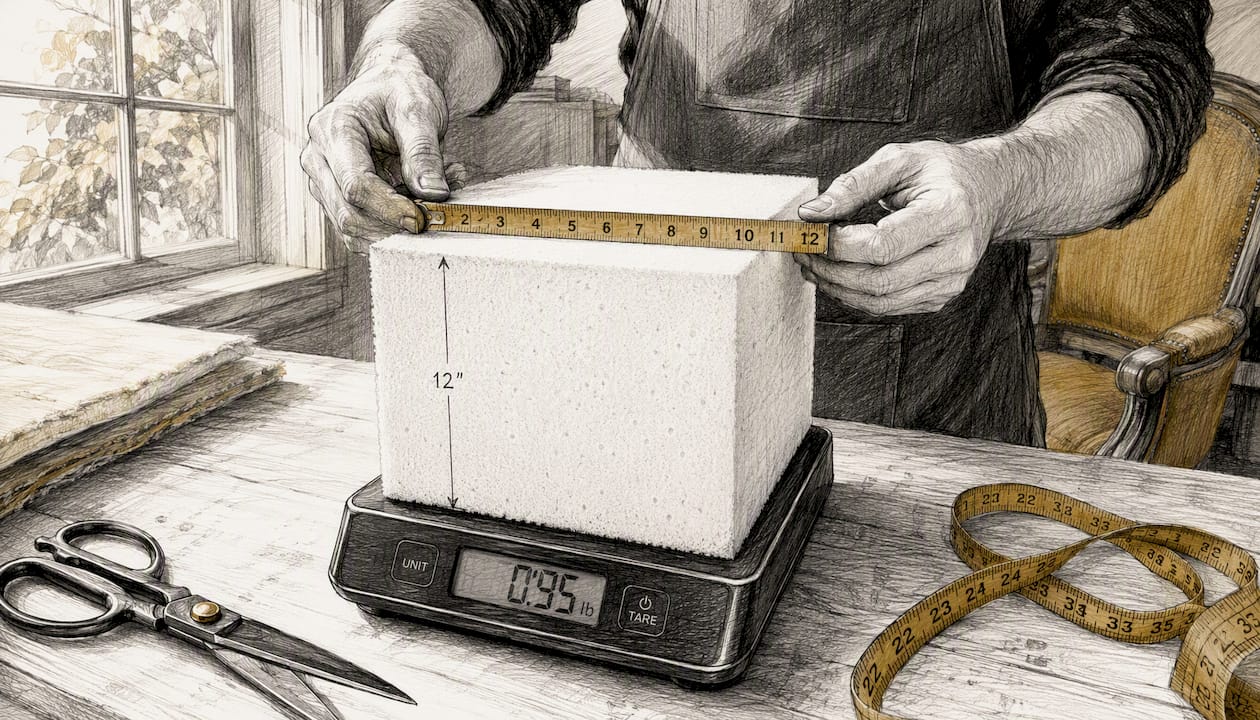
Low numbers mean more air, less material, and faster breakdown. Higher numbers mean more material per unit of volume, which translates to better shape retention over time. Most residential seat cushions fall in the 1.5–2.5 lbs/ft³ range, with an industry average around 1.8 lbs/ft³.
Reading a supplier label is simple once you know what to look for:
- Density is listed in lbs/ft³ (sometimes written as PCF — pounds per cubic foot)
- Grade names like “standard,” “high density,” or “HD” vary by retailer and are not standardized — always look for the actual number
- CertiPUR-US certification on the label means the foam has been tested for harmful chemicals and meets emissions standards — a useful baseline when comparing products
Pro Tip: If a product page or foam supplier only lists “medium density” or “HD” without a number, ask for the spec sheet. Vague grade labels are not interchangeable between manufacturers. A supplier’s “HD” might be 1.8 lbs/ft³ at one company and 2.2 lbs/ft³ at another.
The Weloveupholstery foam density guide for couch cushions goes deeper on how density affects pressure distribution across different seat widths and frame types — worth reading before you order a replacement core.
How does density differ from firmness, and why do both specs matter?
These two numbers measure completely different things, and confusing them is the single most common mistake homeowners make when ordering replacement foam.
Density (lbs/ft³) predicts durability. It tells you how much material is in the foam and, by extension, how long it will resist compression fatigue. A high-density foam holds its shape through years of use. A low-density foam feels fine on day one and starts bottoming out within a year or two.
Low ILD (15–25) feels soft and plush. Medium ILD (25–35) gives a balanced, supportive feel. High ILD (35–45+) feels firm, like a dining chair pad or a bench cushion. Density measures material per volume; ILD measures compressive firmness — both specs are needed for a repeatable cushion build.
Here’s where it gets counterintuitive: a 2.5 lbs/ft³ foam can have an ILD of 18 and feel like a cloud. A 1.4 lbs/ft³ foam can have an ILD of 45 and feel like a park bench. Density and firmness are independent axes. You need to specify both.
Typical ILD ranges by application:
- Sofa seat cushions: ILD 30–40 (medium-firm support)
- Recliner seats: ILD 28–35 (slightly softer for extended sitting)
- Dining chair pads: ILD 40–50 (firm, upright support)
- Back cushions: ILD 20–28 (softer, yielding)
- Decorative pillows: ILD 15–22 or fiber fill
Pro Tip: Before committing to a large foam order, ask the supplier for a 4" × 4" sample at your chosen density and ILD. Sit on it, press it, and let it recover. A sample costs almost nothing and prevents a $150 mistake on a full cushion core.
What are the common foam density ranges and which cushion type fits each?
Foam grades break into four practical bands. The numbers below reflect standard industry usage, though retailer labeling varies.
| Density Range | Common Label | Typical ILD | Best For | Expected Comfort Life |
|---|---|---|---|---|
| 1.0–1.4 lbs/ft³ | Economy / Low | 15–25 | Decorative pillows, throw cushions | 1–3 years |
| 1.5–1.8 lbs/ft³ | Standard / Residential | 25–35 | Back cushions, guest seating, light-use chairs | 3–5 years |
| 2.0–2.4 lbs/ft³ | High-Density Residential | 30–40 | Primary sofa seats, recliners, everyday dining chairs | 5–10 years |
| 2.5+ lbs/ft³ | HR / Commercial | 35–45 | Heavy-use primary seating, commercial furniture, users over 200 lbs | 10+ years |
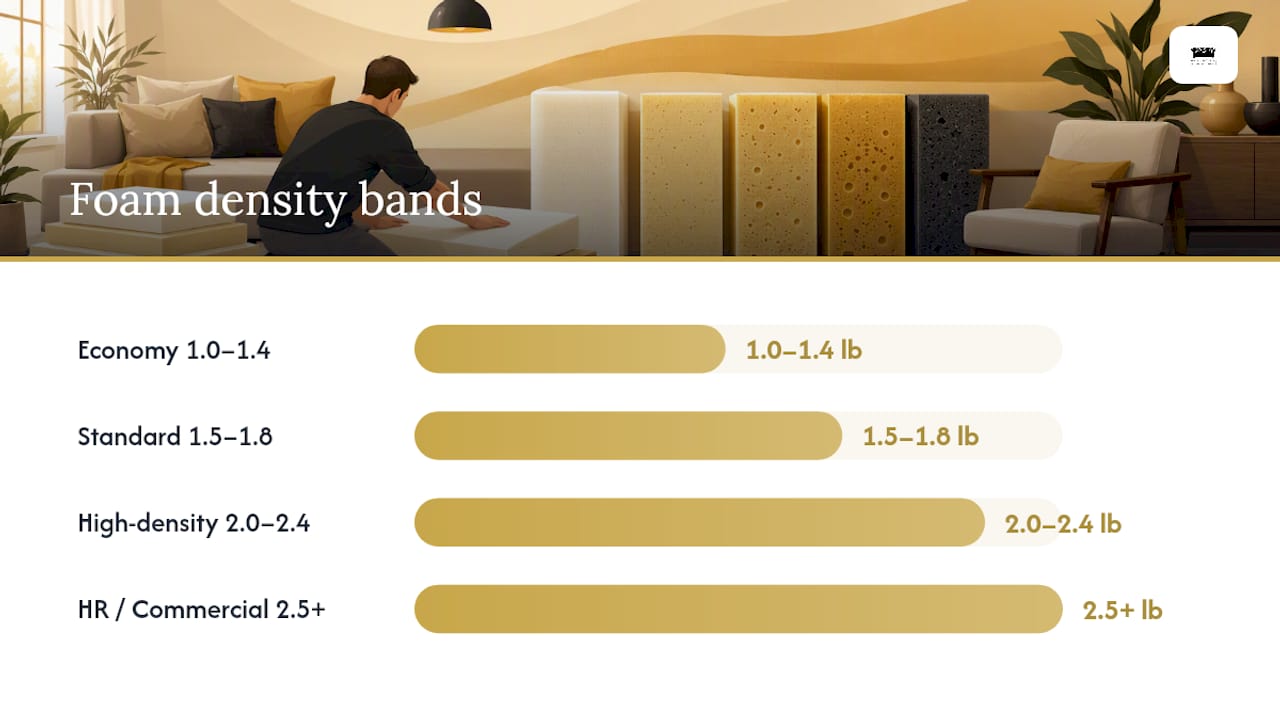
Sofa seat cushions typically call for 2.0–2.5 lbs/ft³ high-resilience foam with an ILD around 35–40; back cushions are usually softer at 1.5–1.8 lbs/ft³. Outdoor cushions sit in their own category: reticulated open-cell foam at 1.8–2.0 lbs/ft³ drains and dries faster than standard polyurethane, making it the practical choice for patio furniture.
For a primary sofa that gets used daily, that premium pays for itself in avoided replacement costs within three to four years. For a guest room chair that sees use a few times a year, the upgrade rarely makes financial sense. Supplier charts mapping density and ILD ranges for stock items are a practical reference when comparing cut-to-size pricing across grades.
What is HR foam, and when should you choose it over standard high-density?
High-resiliency foam is a specific foam construction, not just a marketing term for “dense.” HR foam is typically associated with densities at or above about 2.5 lbs/ft³ and is manufactured with a more uniform cell structure that gives it faster recovery after compression. When you stand up from an HR cushion, it springs back quickly. Standard high-density foam at 2.0–2.4 lbs/ft³ recovers more slowly and can develop a permanent set over time.
Why HR matters for primary seating: The slow-sinking feeling that makes an older sofa feel like a trap is usually a density problem, but the “dead” feeling where the cushion never quite bounces back is an HR problem. HR foam addresses both.
Common foam types and when to use each:
- Standard polyurethane (1.5–2.4 lbs/ft³): The workhorse for most residential cushions. Affordable, widely available, and adequate for moderate use.
- HR polyurethane (2.5+ lbs/ft³): Best choice for primary living room seating, heavy users, and anyone who wants a cushion that performs consistently for a decade.
- Memory foam (viscoelastic): Responds to body heat and conforms slowly. Works well as a 1–2" comfort layer on top of a firm HR base, but performs poorly as a standalone seat core — it bottoms out under sustained weight and retains heat.
- Reticulated open-cell foam: The standard for outdoor cushions. Its open lattice structure allows water to drain through rather than pool inside. Recommended density is 1.8–2.0 lbs/ft³ for outdoor seat cores.
- Layered builds: A 3–4" HR base topped with 1" of softer foam or Dacron batting gives you durability at the core and a plush surface feel — a common professional approach for high-end sofa cushions.
Pro Tip: For long-session seating like a home office chair or a gaming setup, cushion density and firmness directly affect posture and hip comfort. A 2.0–2.5 lbs/ft³ foam at ILD 30–35 gives enough support to prevent the pelvis from tilting backward, which is the root cause of most lower-back fatigue in soft seating.
How does foam density affect durability, and when is an upgrade worth it?
Higher density generally means a longer comfort life, but the relationship isn’t perfectly linear. What density actually determines is how many compression cycles the foam can handle before it loses meaningful support. A 1.5 lbs/ft³ foam might feel fine for the first year, then degrade noticeably in year two. A 2.5 lbs/ft³ HR foam can maintain its support profile for a decade of daily use.
Realistic lifespan expectations by density:
- 1.0–1.4 lbs/ft³: 1–3 years before noticeable softening; fine for decorative use
- 1.5–1.8 lbs/ft³: 3–5 years of comfortable support in moderate use
- 2.0–2.4 lbs/ft³: 5–10 years; the practical sweet spot for most residential sofas
- 2.5+ lbs/ft³ HR: 10+ years in primary seating; worth the cost for daily-use furniture
Household scenarios and what to do:
- Family with kids and pets using the sofa daily: Go to 2.5 lbs/ft³ HR. The cost difference over a 10-year period is negligible compared to replacing cushion cores every three years.
- Two-person household, moderate sofa use: 2.0–2.2 lbs/ft³ is sufficient and more budget-friendly.
- Guest room chair or secondary seating: 1.8 lbs/ft³ standard foam is a reasonable choice.
- Decorative accent cushions: 1.0–1.4 lbs/ft³ or fiber fill; durability is not the priority here.
Retail product listings for 1.8 lbs/ft³ “high density” foam often carry vendor-estimated lifespans of 7–10 years, which is a useful benchmark when comparing replacement options — though actual lifespan depends heavily on use frequency and user weight.
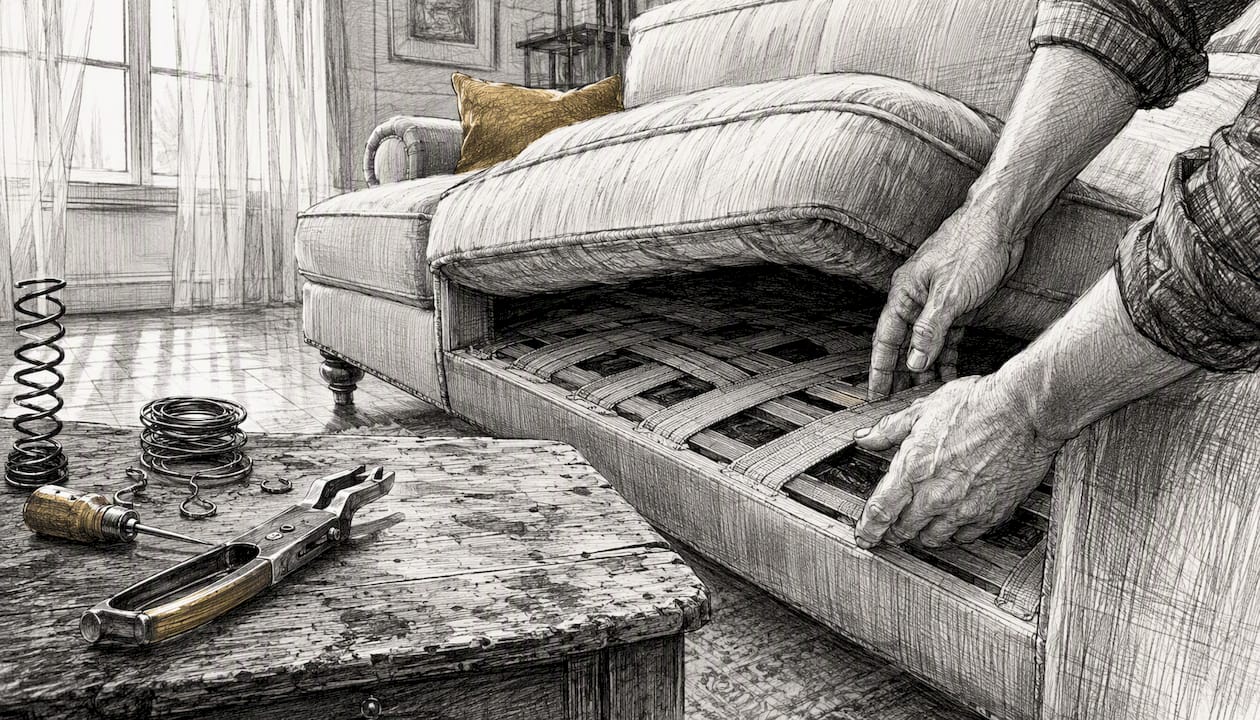
One factor most homeowners overlook: foam density cannot compensate for a failing support deck. If the webbing, springs, or platform base beneath the cushion is sagging, even 2.5 lbs/ft³ HR foam will feel soft within a year. Inspect the sofa’s back support and deck structure before spending money on premium foam.
How do you choose the right foam density for your cushion project?
Start with the use case, not the budget. The density decision flows from how the cushion will be used, who will use it, and how long you want it to last.
Step-by-step decision checklist:
- Identify the use level. Daily primary seating, occasional use, or decorative only?
- Note the sitter weight. Users over 200 lbs compress foam faster; move up at least one density band.
- Measure the cushion dimensions. Length, width, and thickness (most sofa seat cores are 4–6" thick).
- Choose your density/ILD pair. Use the ranges in the table above as your starting point.
- Decide on wrap or batting. A 1" Dacron wrap over the foam core softens the feel without sacrificing density-driven durability.
- Set a lifespan target. If you want 8+ years, don’t go below 2.0 lbs/ft³ for a seat cushion.
Questions to ask your foam vendor before ordering:
- What is the exact density in lbs/ft³ (not just the grade name)?
- What is the ILD or IFD rating?
- Is the foam CertiPUR-US certified?
- Can you cut to my exact dimensions, and what is the cutting tolerance?
- Do you offer samples before a full order?
- What is the return or exchange policy if the feel is wrong?
Red flags to walk away from:
- No density number listed, only vague labels like “medium” or “firm”
- No ILD specification available
- Supplier unwilling to provide a sample
- No CertiPUR-US certification or equivalent safety standard mentioned
A quick sit test protocol: if you can visit a showroom or supplier, sit on the foam sample for at least 60 seconds. Stand up and watch how fast it recovers. A good HR foam returns to shape within 2–3 seconds. Slow recovery or a permanent impression after a short sit is a sign of low density or poor resilience.
Specifying density and ILD together prevents the most common cause of early cushion failure — and it’s the difference between a reupholstery job that holds up and one that needs a callback within 18 months.
Step-by-step DIY guide to replacing a sofa seat cushion core
For a standard sofa seat replacement, the target build is 2.0–2.5 lbs/ft³ HR foam, ILD 35–40, cut to 4–5" thickness, wrapped in 1" Dacron batting. That combination gives a firm-but-comfortable feel that holds up under daily use.
Tools and materials you’ll need:
- Measuring tape and a marker
- Electric carving knife or serrated bread knife (for trimming)
- Spray adhesive (3M Super 77 or equivalent upholstery-grade)
- Dacron batting (1–2 oz weight)
- Scissors
- Safety glasses and a dust mask
- Replacement foam cut to size (order from a supplier with density and ILD specified)
- Straight pins or basting clips for test-fitting
Find a full materials checklist at Weloveupholstery’s materials and supplies archive.
Step-by-step procedure:
- Remove the old foam. Unzip or open the cushion cover and pull out the existing core. Note its dimensions and condition — if it’s completely flat, you’re replacing it at the right time.
- Measure accurately. Measure the interior of the cushion cover: length, width, and depth. For a snug fit, add ¼" to ½" to each dimension — foam compresses slightly when inserted, and a slightly oversized core fills the cover better than an undersized one.
- Order or cut the foam. Most suppliers offer cut-to-size service. Specify: density (lbs/ft³), ILD if available, thickness, and whether you want a crowned edge (slightly rounded top) for a fuller look. If cutting yourself, use an electric carving knife with a long blade and cut in one smooth pass — sawing back and forth tears the cell structure.
- Test-fit the core. Before wrapping, slide the bare foam into the cover. It should fit snugly but not require forcing. Trim small amounts at a time if needed.
- Wrap in Dacron batting. Cut the batting to wrap around the top and sides of the foam core. Secure it with light spray adhesive. This layer softens the surface feel and gives the cushion a fuller, more tailored appearance.
- Insert and test. Slide the wrapped core into the cover and zip or close it. Sit on it for a few minutes. The cushion should feel firm initially and soften slightly as the foam adjusts to your weight.
- Trim for cover fit. If the cover pulls or the zipper strains, remove the core and trim ¼" from the edges. Retest.
Common pitfalls:
- Ordering foam to the exact cover measurement with no added allowance — the result is a loose, floppy cushion
- Skipping the Dacron wrap — the foam edge feels hard and the cover shows the foam’s shape through the fabric
- Using a standard kitchen knife instead of a long serrated blade — it compresses and tears the foam rather than cutting cleanly
Supplier order form checklist: density (lbs/ft³), ILD or firmness grade, thickness, length, width, edge type (square or crowned), and cutting tolerance (±¼" is standard).
Pro Tip: Before installing new foam, inspect the support deck. Press down on the webbing or platform base with both hands. If it flexes more than an inch or feels uneven, repair or replace it before adding the new core. A T-cushion sofa reupholstery guide covers the full process including deck inspection for common sofa configurations.
What I actually spec on real projects, and why
The conventional wisdom in most foam guides is to recommend 1.8 lbs/ft³ as the default “good enough” density for residential sofas. That number is fine for a guest chair. For a primary sofa — the one that gets sat on every evening, that kids pile onto, that the dog claims as a second bed — 1.8 lbs/ft³ is underselling the project.
My go-to for everyday sofas is 2.2–2.5 lbs/ft³ HR foam at ILD 36–38, wrapped in 1" Dacron. That combination holds its profile for years without feeling like a church pew. The HR construction is what makes the difference: the cushion springs back after each use rather than slowly compressing into a permanent impression.
The argument I hear against this is cost. A 2.5 lbs/ft³ HR core costs more than a 1.8 lbs/ft³ standard core. But when you factor in that a lower-density core in a high-use sofa often needs replacing in three to four years, the math flips quickly. The checklist and DIY recipe in this guide give you everything you need to order the right core the first time and avoid that cycle entirely.
Weloveupholstery guides take the guesswork out of foam selection
Knowing the right density is step one. Finding the right foam, cutting it correctly, and finishing the cushion so it looks and feels professional is where most DIY projects stall.

Weloveupholstery publishes step-by-step DIY upholstery guides written by practitioners who have replaced hundreds of cushion cores — covering everything from measuring and ordering foam to wrapping, fitting, and finishing. The guides include materials lists, tool recommendations, and supplier notes so you’re not piecing together advice from a dozen different sources. If you’re ready to start your cushion replacement project, the materials and supplies archive lists vetted foam sources, batting options, and adhesives that work for residential DIY builds. Pick your density, follow the recipe, and get a cushion that actually lasts.
Sources
These references were used throughout this guide and are worth bookmarking when ordering foam or comparing supplier specs:
- Measuring Foam Density and What it Means for Your Furniture
- High Density Upholstery Foam Cushion Replacement – Medium Firm Sofa Seat Foam Cut to Size – Cushion Palace