Heads up: this post contains affiliate links. If you buy through them, We Love Upholstery may earn a small commission at no extra cost to you.
Bonded polyester wins for outdoor, marine, and UV-exposed work; bonded nylon wins for heavy indoor upholstery, leather, and other high-abrasion seams. That’s the whole decision in one sentence.
The reason comes down to two competing strengths. Bonded nylon delivers slightly higher tensile strength and better abrasion resistance, which is why it dominates leather and automotive interiors. Bonded polyester holds its strength and color under sunlight and resists moisture far better, which is why it’s the standard for anything left outside. Both come coated with a resin finish, and both get sized by denier or tex, the two measurement systems you’ll see on every spool at the fabric counter — for more details on thread types, see our Embroidery Specialty Thread Types: A Crafter’s Guide. At Weloveupholstery, we’ve sewn enough sample seams to know that picking the wrong one isn’t a small mistake. It’s the difference between a seam that lasts a decade and one that fails in a summer.
- Outdoor cushions, awnings, boat covers, tents: bonded polyester
- Leather furniture, automotive seats, heavy indoor upholstery, footwear: bonded nylon
- One-line tradeoff: polyester lasts longer outdoors; nylon holds tighter under mechanical stress
Key Takeaways
Bonded polyester resists UV and moisture better for outdoor projects, while bonded nylon offers stronger abrasion resistance for heavy indoor and leather work.
| Point | Details |
|---|---|
| Match thread to environment | Use bonded polyester outdoors and bonded nylon for high-friction indoor seams like leather. |
| Moisture absorption differs sharply | Polyester absorbs about 0.4% moisture versus roughly 4% for nylon, affecting seam stability. |
| Bonding improves sewability | The resin coating reduces fraying, heat, and friction at high sewing speeds on both fiber types. |
| Test before you commit | Sew a scrap seam under real conditions since vendor specs don’t always match independent testing. |
| Weloveupholstery guides the whole project | Its fabric guide and DIY tutorials help you pair the right thread with the right materials and technique. |
Table of Contents
- Bonded Nylon vs Polyester Thread at a Glance
- What Does “Bonded” Actually Mean?
- Which Thread Is Stronger, and Which Lasts Longer Outdoors?
- How Do You Choose the Right Thread for Your Project?
- Getting the Best Results When You Sew
- How Long Do Bonded Thread Seams Actually Last?
- What Actually Held Up in Real Testing
- Get More From Your Next Repair With Weloveupholstery
- Sources
Bonded Nylon vs Polyester Thread at a Glance
Here’s how the two stack up across the dimensions that actually matter for a project, not just on paper.
| Dimension | Bonded Nylon | Bonded Polyester |
|---|---|---|
| Tensile strength | Slightly higher for the same thickness | Slightly lower, but close with high-tenacity filament |
| UV resistance / outdoor life | Degrades faster in sunlight | Holds strength and color much longer outdoors |
| Abrasion resistance | Excellent, best for high-friction seams | Very good, slightly behind nylon |
| Elasticity / stretch | More stretch, absorbs shock | Low stretch, dimensionally stable |
| Moisture behavior | Absorbs more moisture, can swell or sag | Absorbs very little, resists mildew |
| Colorfastness | Fades faster under sun | Retains color much longer |
| Common uses | Leather, auto interiors, heavy upholstery, footwear | Marine, awnings, outdoor furniture, tents |
| Typical weights / needles | Tex 40, needles 90/14 | Tex 40, needles 90/14 |
For quick picks: leather seats call for bonded nylon, boat cushions and tent seams call for bonded polyester, and outdoor patio furniture almost always does better in polyester because of the sun exposure. A few vendor pages list nylon with strong UV numbers. Treat those as vendor specs to verify, not as the final word.
What Does “Bonded” Actually Mean?
“Bonded” refers to a resin coating applied over the thread’s core filaments, and it’s what separates a thread built for machine sewing from one that isn’t. The coating reduces fraying and cuts down on heat buildup as the thread races through the needle at high speed, which matters enormously on a walking-foot machine chewing through leather or vinyl.
Manufacturers typically use one of a few coating chemistries to get there:
- Nonionic polyethylene emulsions, which add slickness without stiffening the thread
- Polysiloxane treatments, which cut friction and reduce needle wear on long production runs
DIYers sometimes blame “cheap thread” when a seam frays or snaps, when the real issue is an unbonded or lightly bonded thread trying to do a bonded thread’s job. Unbonded thread still has its place in some embroidery and finishing work where the coating would interfere with adhesion, but for upholstery and leather, bonded is the default.
Pro Tip: Before switching thread brands mid-project, sew a six-inch test seam on scrap material at your normal speed and tension. If you hear a high-pitched squeal or see lint building up at the needle, that thread isn’t bonded well enough for the job.
Which Thread Is Stronger, and Which Lasts Longer Outdoors?
Nylon typically edges out polyester in raw tensile strength at the same thickness. That’s the number you’ll see quoted on spec sheets, and it’s real. But raw strength on day one isn’t the same question as strength after a summer on a patio chair.
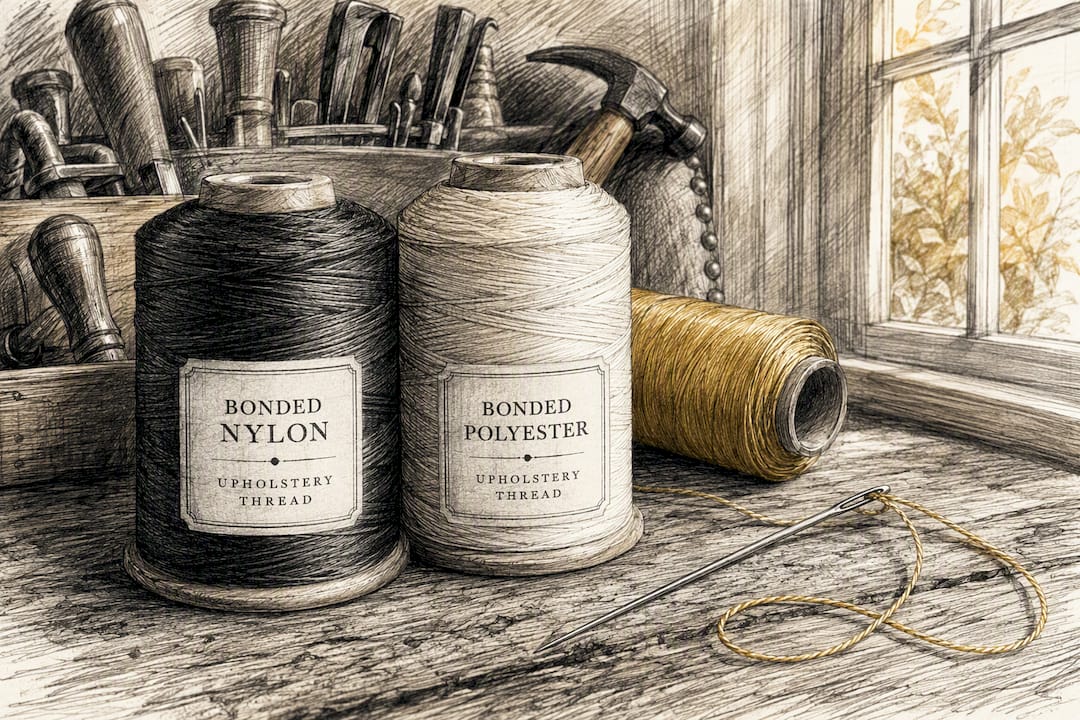
Nylon degrades under UV exposure faster than polyester does, losing tensile strength and fading in color the longer it sits in direct sun. Polyester holds onto both its strength and its color far longer under the same conditions. So the thread that “wins” on a lab spec sheet is often the one that fails first on a deck cushion.
| Property | Bonded Nylon | Bonded Polyester |
|---|---|---|
| Initial tensile strength | Higher | Slightly lower |
| Strength retention after UV exposure | Weakens noticeably | Retains most of its strength |
| Moisture absorption | Roughly 4% | Roughly 0.4% |
| Elasticity | More give, absorbs shock loads | Minimal stretch, holds shape |
That moisture gap is the one number worth memorizing. Polyester fibers absorb around 0.4% moisture compared to roughly 4% for nylon, a tenfold difference that explains why nylon seams can sag or loosen after a rainy week outdoors while polyester barely notices.
Abrasion resistance tells a different story. Nylon’s extra elasticity lets it flex and absorb shock at stress points, which is exactly why it holds up on a car seat bolster or a leather chair arm that takes constant friction. Polyester’s low stretch is an asset indoors too, though, since it keeps seams from loosening over time on furniture that doesn’t move much.
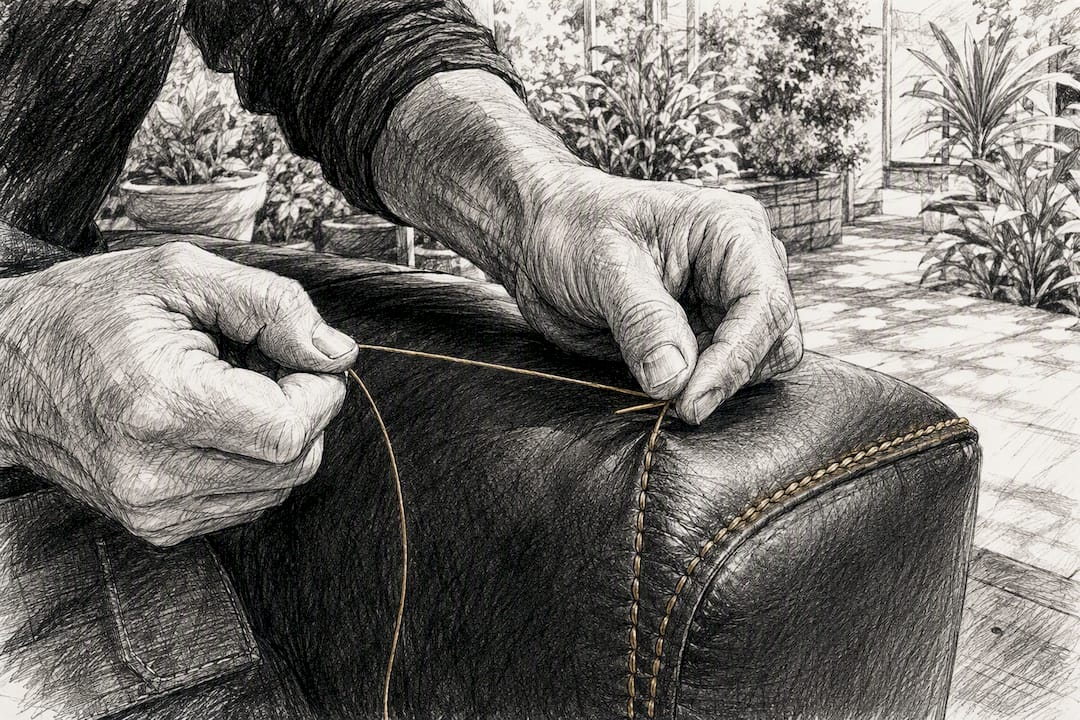
High-tenacity continuous-filament polyester has closed much of the old strength gap, making it viable for heavy-duty outdoor gear where UV resistance used to force a strength tradeoff. Always test both threads on a scrap of your actual material before committing a full project to one or the other. Spec sheets describe averages, not your specific fabric or leather.
How Do You Choose the Right Thread for Your Project?
A few rules of thumb cover most of what you’ll run into.
- Anything that lives outside, boat covers, awnings, tents, patio cushions gets bonded polyester
- Leather furniture, automotive interiors, heavy indoor upholstery, and footwear get bonded nylon
- When in doubt about sun exposure, default to polyester. UV damage is harder to reverse than a slightly weaker seam
- Match thread weight to material thickness: lighter denier for thin fabrics, heavier tex for leather and multiple layers of padding
- Vendors selling Tex 70 bonded nylon in large cones for upholstery shops are describing a production-grade thread built for volume, not a guarantee it beats polyester outdoors
Thread weight matters as much as fiber type. A lightweight tex 40 nylon won’t hold a heavy leather seat cushion together, no matter how strong the fiber chemistry is on paper. Step up to tex 70 or higher for structural seams, and always run a short test seam on your actual material stack before cutting into good fabric.
Hybrid approaches make sense more often than people expect. A boat cushion might get bonded polyester on the exposed topstitching and bonded nylon on structural seams buried inside where sun never reaches. Marine upholsterers do this routinely.
Pro Tip: If a project has both exposed and hidden seams, like a cushion with a zipper flap that sits in full sun, use polyester on anything visible and save nylon for the seams doing the structural work underneath.
Getting the Best Results When You Sew
Bonded thread sews best with a needle one size larger than you’d use for unbonded thread of the same weight. That extra clearance cuts friction and heat, which is exactly what the resin coating is designed to reduce in the first place.
- Use a walking foot on multiple layers of leather or heavy vinyl to prevent skipped stitches
- Slow your machine speed slightly when working with tex 70 or heavier thread to avoid heat buildup at the needle
- Keep the bobbin area lightly lubricated on older machines to reduce drag
For finishing, seal polyester thread ends with a fray-check style seam sealer rather than heat, since heat can damage the bonding coating itself. Backstitch at the start and end of every seam instead of tying knots. Knots add bulk and tend to work loose on thread with any stretch.
Pro Tip: If you’re getting skipped stitches on heavy leather, check your needle size before blaming the thread. A 90/14 needle straining through six layers of leather will skip no matter how good the thread is.
How Long Do Bonded Thread Seams Actually Last?
Inspect seams a few times a year for early warning signs: fading or chalky-looking fiber (UV damage), fraying at pressure points like armrests, and loose or sagging stitches after heavy rain or humidity.
- Re-stitch small frays immediately rather than waiting for a full seam failure
- Match repair thread weight to the original; mixing a lighter thread into a heavy seam creates a new weak point
- Apply a seam sealer to exposed polyester repairs on outdoor furniture to slow future UV wear
Outdoor polyester seams commonly outlast nylon seams left in the same conditions, sometimes by years, while nylon indoors on low-UV furniture can outlast its outdoor counterpart by a wide margin simply because it never faces the sun.
What Actually Held Up in Real Testing
Sample stitches tell you more than any spec sheet. On leather test strips, bonded nylon consistently outlasted polyester before fraying under repeated flexing. On fabric left in direct sun for several weeks, polyester held its color and strength while nylon visibly yellowed and weakened.
Before starting a big job, run these checks:
- Stitch a scrap seam at full machine speed and listen for squealing or smoking
- Flex a test seam repeatedly to check for early fraying
- Leave a sample outdoors for a week if the project involves sun exposure
| Point | Details |
|---|---|
| Test before committing | Always sew a scrap seam under real conditions before cutting into good material. |
| Nylon wins indoors | Its stretch and abrasion resistance hold up best on leather and heavy upholstery. |
| Polyester wins outdoors | Lower moisture absorption and better UV resistance make it last longer in the sun. |
A Pragmatic Take on Mixing Thread Types
The smartest approach often isn’t picking one thread for an entire piece. Use polyester where sun and moisture hit hardest, nylon where structural load matters most, and always verify vendor claims on scrap before trusting a spec sheet on a real seam.
Get More From Your Next Repair With Weloveupholstery
Picking the right bonded thread only pays off if the seam around it is built correctly, and that’s where a step-by-step reference beats guesswork. Weloveupholstery’s upholstery fabric guide walks you through matching fabric weight to thread weight so your seams don’t fail where the material can’t support them.

Whether you’re patching a leather armchair or rebuilding a dining chair seat, our DIY guides cover the sewing and finishing steps this article touched on, in full project detail. If you’re stocking up on needles, thread cones, or seam sealers, check our materials and supplies reference before you sit down at the machine. Start your next repair with the fabric guide open beside you, and you’ll spend less time guessing and more time sewing.
Sources
- Bonded Nylon vs. Bonded Polyester Thread: The 2026 Industrial Guide
- Polyester Thread vs Nylon Thread: The Ultimate Guide for Machine Embro MaggieFrameStore
- Upholstery Thread and Needle: A How-To Guide for Durable Designs B-Sew Inn
- Bonded Nylon #69 Thread: For Heavy Leather Work JourneymanHQ
FAQ
Which thread is stronger, bonded nylon or bonded polyester?
Bonded nylon typically tests slightly stronger at the same thickness, but polyester retains more of its strength over time outdoors because it resists UV degradation better.
What does “bonded” mean on a spool of thread?
It means the fibers are coated in a resin, often a polyethylene emulsion or polysiloxane treatment, that reduces fraying, friction, and heat during machine sewing.
Is bonded nylon or polyester better for outdoor furniture?
Bonded polyester is the better choice for outdoor furniture because it resists UV fading and absorbs far less moisture than nylon.
What needle size should I use with bonded thread?
Go one size larger than you would for unbonded thread of the same weight to reduce friction and heat as the thread passes through the fabric.
Can I mix bonded nylon and polyester on the same project?
Yes. Many marine and outdoor upholstery projects use polyester on exposed, sun-facing seams and nylon on hidden structural seams for the best of both properties.