Heads up: this post contains affiliate links. If you buy through them, We Love Upholstery may earn a small commission at no extra cost to you.
T-cushion sofa reupholstery is the process of replacing or renewing the foam cores, Dacron batting, and fabric covers on sofas with the distinctive T-shaped front cushion design. Done right, it costs a fraction of buying new furniture. Replacement cushions run 50–70% less than a new sofa, and a full reupholstery project can add a decade of life to a frame that still has good bones. This guide walks you through every stage: materials, measuring, execution, and long-term care.
What materials and tools do you need for t-cushion sofa reupholstery?
Getting your supply list right before you start saves you two trips to the fabric store and one moment of regret. T-cushion sofas require specific materials because of their shape. The front notch of the T creates seam complexity that flat-cushion sofas simply don’t have.
Fabric options for t-cushion covers
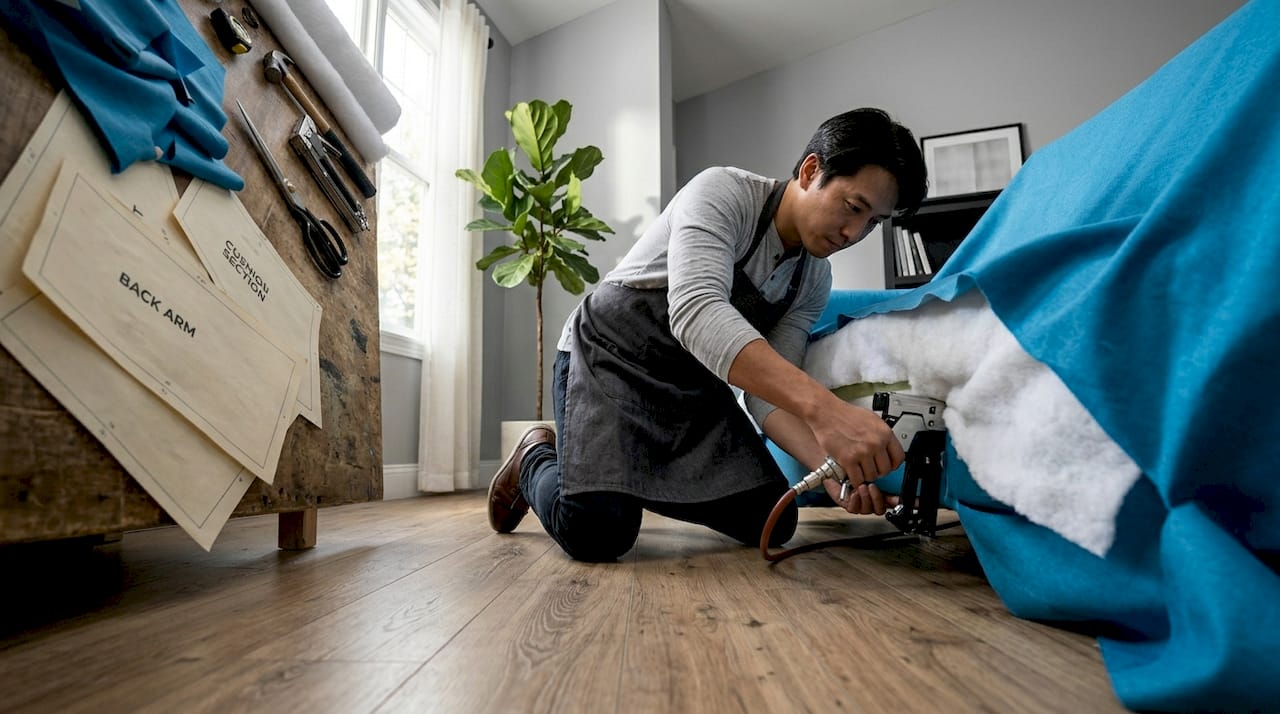
The best fabrics for reupholstery on a t-cushion sofa balance durability with workability. Crypton and Sunbrella are performance fabrics that resist stains and wear, making them ideal for high-traffic living rooms. Canvas and duck cloth are budget-friendly and easy to sew, though they show wear faster. Velvet and linen look beautiful but require more precise cutting and are harder to clean. For most homeowners doing a first project, a medium-weight upholstery fabric in the 10 to 15 oz range hits the right balance between ease of handling and longevity.
Foam types and what they actually mean
Foam density and Dacron wrap thickness are the two variables that determine how your cushion feels and holds its shape over time. HD36 is the industry standard for sofa seat cushions. It offers a firm, supportive base that resists compression over years of use. EverFlex foam adds a softer top layer for a more plush feel without sacrificing support. Dacron batting, the polyester wrap applied over the foam, controls the cushion’s crown and prevents the fabric from looking boxy or saggy. Skipping Dacron is one of the most common DIY mistakes.
Here is a quick comparison of the most common material choices and their typical costs:
| Material | Best use | Approx. cost |
|---|---|---|
| HD36 foam (standard) | Seat cushions, firm support | $40–$80 per cushion |
| EverFlex foam | Seat cushions, softer feel | $60–$100 per cushion |
| Dacron batting (1 inch wrap) | All cushion types | $10–$20 per cushion |
| Sunbrella fabric | High-traffic or pet households | $30–$60 per yard |
| Duck cloth / canvas | Budget DIY projects | $8–$18 per yard |
Tools you need before you start
- Electric staple gun (Arrow T50 or equivalent) with 3/8 inch staples
- Sharp fabric scissors or a rotary cutter with cutting mat
- Measuring tape and a fabric marker
- Seam ripper for removing old covers cleanly
- Sewing machine capable of handling upholstery thread (size 16 or 18 needle)
- Spray adhesive for bonding Dacron to foam
You can find a detailed breakdown of upholstery supply materials at Weloveupholstery, including foam grades and batting options suited to DIY projects.
How to properly measure sofa cushions before reupholstery
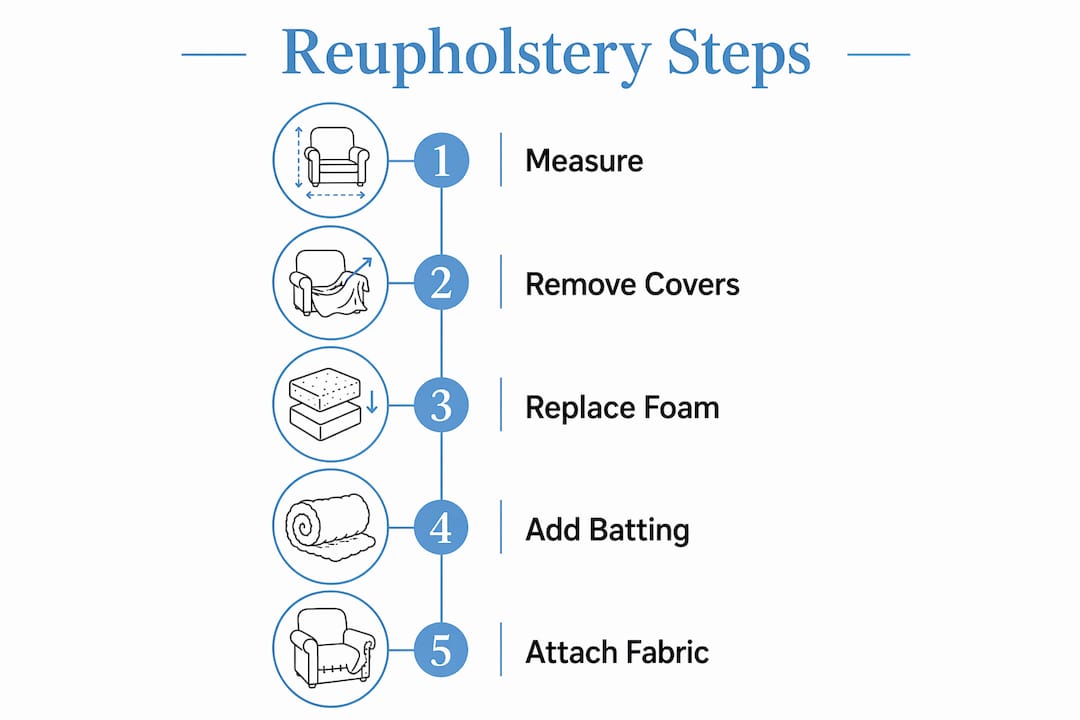
Measurement errors are the number one reason DIY cushion projects fail. A cover that is a quarter inch too tight will split at the seams. Foam that is cut too small will shift inside the cover and create lumps. Precision here is not optional.
Follow these steps for accurate cushion measurement:
- Remove the cushion from the sofa and place it on a flat surface. Never measure while the cushion is on the sofa frame.
- Measure width at the widest point of the T shape, including both side wings. Write this number down.
- Measure depth from front to back at the deepest point of the cushion.
- Measure thickness from the bottom to the top of the cushion at its center.
- Add 0.5 to 0.75 inches to each foam dimension to account for foam compression and achieve a snug, full-looking cushion.
- Measure the T notch separately. Record the depth and width of each notch cutout. These dimensions determine your fabric seam placement.
- Check the existing cover for stretch. If the fabric has significant give, reduce your foam dimensions slightly to compensate.
One critical nuance: rounding foam dimensions down is always preferable to rounding up. A foam core that is slightly too large will fight you during installation and stress the cover seams from day one.
Pro Tip: Before cutting any new foam, check whether your cushion covers have zippers. Cushions with removable covers and zippers allow a clean foam swap without touching the fabric at all. If your covers are in good shape and the zippers work, you may only need new foam, which cuts your project time and cost significantly.
Common measuring mistakes to avoid include measuring a compressed or worn cushion without accounting for its original dimensions, ignoring the T notch measurements entirely, and measuring only one cushion when multiple cushions on the same sofa can vary slightly in size.
Step-by-step process for reupholstering a t-cushion sofa
This is where the project comes together. Work through each stage in order. Skipping steps to save time almost always creates problems that take longer to fix than the time you saved.
Stage 1: Disassembly
- Remove all cushions from the sofa frame and set them aside.
- Use a seam ripper to open the existing covers carefully along the seams. Preserve the old cover pieces. They serve as your cutting templates for the new fabric.
- Pull out the old foam and Dacron. Note how the Dacron was applied, whether it wrapped all sides or just the top.
- Inspect the cushion casing (the inner fabric shell, if present) for tears or zipper damage. Casing and zipper condition directly affects how much additional labor your project requires.
Stage 2: Foam and Dacron installation
- Cut your new foam to the measured dimensions using an electric carving knife or serrated bread knife. A straight cut matters more than speed here.
- Apply spray adhesive to the top and sides of the foam block.
- Wrap Dacron batting around the foam, starting at the top and pulling it snug on all sides. Secure the Dacron at the bottom with a few staples or a light spray of adhesive.
- For t-cushion shapes specifically, cut the Dacron to follow the T outline before wrapping. Bunched Dacron at the notch corners creates visible lumps under the finished fabric.
Pro Tip: Use two layers of Dacron on the top surface only if you want a softer, more rounded crown. One layer on all sides gives a firmer, more tailored look. The choice depends on your sofa style and personal preference.
Stage 3: Cutting and fitting new fabric
- Lay your old cover pieces flat on the new fabric and trace around them with a fabric marker, adding a 1/2 inch seam allowance on all edges.
- Cut the T shape carefully. The inside corners of the T notch are the trickiest part. Use sharp scissors and cut slowly.
- Sew the top and bottom panels together, leaving the back edge open for inserting the foam.
- If you are installing a zipper, sew it into the back seam before closing the cover.
Stage 4: Finishing the cushion
- Slide the foam and Dacron assembly into the new cover through the back opening.
- Work the foam into the corners of the T shape by hand, pushing gently until the cover sits flush.
- Close the back seam by hand stitching or zip closure.
- For sofa frame sections (not removable cushions), use a staple gun to secure fabric to the frame, pulling the fabric taut before each staple.
Common problems during this stage include fabric puckering at the T notch corners, which is fixed by clipping the seam allowance close to the corner before turning the cover right side out. Foam that will not seat properly usually means the cover is slightly too small or the Dacron wrap is too thick for the opening.
- Check all seams for gaps before considering the cushion finished
- Fluff and reshape the cushion by hand after installation
- Let the cushion sit on the sofa for 24 hours before judging the final appearance
For more detailed guidance on handling tricky seam work, the curved sofa back reupholstery guide at Weloveupholstery covers similar precision techniques.
How to maintain reupholstered t-cushion sofas
A well-executed reupholstery job deserves proper care. Foam replacement alone typically runs $80 to $250 per cushion and can extend a sofa’s life by another decade. Protecting that investment takes less effort than most people expect.
- Rotate cushions monthly to distribute wear evenly across all seating positions.
- Vacuum upholstery fabric weekly using a soft brush attachment to prevent dirt from working into the fibers and degrading the material.
- Spot clean spills immediately with a clean cloth and a fabric-appropriate cleaner. Blot, never rub.
- Avoid direct sunlight on the sofa for extended periods. UV exposure fades fabric and degrades foam faster than normal use.
- Inspect seams every six months for early signs of loosening. Catching a loose seam early takes minutes to fix. Ignoring it leads to a full cover replacement.
Pro Tip: Multi-piece slipcovers designed specifically for t-cushion sofas are an excellent protective layer over your new fabric, especially in households with kids or pets. They wash easily and take the daily abuse so your reupholstered fabric underneath stays pristine.
When foam begins to feel noticeably softer or you see the cushion surface sinking unevenly, that is the signal to refresh the foam core rather than the fabric. Addressing foam degradation early prevents the fabric cover from stretching out of shape, which would require replacing both.
Key takeaways
Successful t-cushion sofa reupholstery depends on accurate measurement, the right foam and Dacron combination, and careful fabric installation in that exact order.
| Point | Details |
|---|---|
| Measure with precision | Add 0.5 to 0.75 inches to foam dimensions and always round down, never up. |
| Choose foam by density | HD36 is the standard for seat cushions; pair it with Dacron batting for shape and comfort. |
| Preserve old covers as templates | Seam-ripped original covers give you exact cutting guides for new fabric. |
| Check zippers before starting | Removable covers with working zippers allow foam-only swaps without full reupholstery labor. |
| Maintain to protect your investment | Rotate cushions, spot clean promptly, and address loose seams before they worsen. |
Why foam density is the detail most DIYers get wrong
I have seen a lot of t-cushion projects go sideways, and the culprit is almost never the fabric choice or the staple gun technique. It is the foam. Specifically, it is homeowners buying whatever foam is cheapest at the craft store without understanding what density numbers actually mean.
A 1.5 lb density foam feels fine in the store. Six months later, it has compressed into a pancake. HD36 foam, which has a 1.8 lb density and a 36 ILD (Indentation Load Deflection) rating, holds its shape under repeated use because it was engineered for exactly that purpose. The difference in cost between cheap foam and HD36 is maybe $20 to $30 per cushion. The difference in lifespan is years.
My other strong opinion: do not skip Dacron. I know it feels like an optional finishing touch, but it is what separates a cushion that looks professionally done from one that looks homemade. The Dacron controls the crown, fills out the corners, and gives the fabric something to grip. Without it, even a perfectly sewn cover looks deflated.
If you are new to reupholstery, start with a single seat cushion before tackling the whole sofa. The skills transfer directly, and a single cushion gives you a low-stakes environment to work out your measuring and sewing technique. By the time you move to the second cushion, you will be significantly faster and more confident. The leather sofa reupholstery guide at Weloveupholstery covers tool technique in depth, and most of those principles apply to fabric work too.
— Dustin
Ready to take your sofa project further?
Weloveupholstery exists to help homeowners like you get real results from DIY upholstery projects, not just inspiration. Whether you are sourcing the right foam grade, figuring out which fabric holds up to your household, or hitting a snag mid-project, the resources here are built around practical execution.

If your cushion covers are showing seam separation after years of use, start with the guide on repairing loose upholstery seams before cutting any new fabric. Fixing the existing structure first saves material and gives you a cleaner base to work from. For a full overview of professional services and DIY supply options, visit the Weloveupholstery offerings page to find the right level of support for your project.
FAQ
What is a t-cushion sofa?
A t-cushion sofa has seat cushions shaped like the letter T, with a front section that extends forward past the armrests. This design is common in traditional and transitional style sofas.
How much does t-cushion sofa reupholstery cost?
Foam replacement runs $80 to $250 per cushion, while full professional reupholstery with fabric and labor costs significantly more. Doing the work yourself cuts costs by 50 to 70% compared to buying a new sofa.
Can I reupholster a t-cushion sofa without sewing?
You can replace foam without sewing if your cushion covers have working zippers. For full fabric replacement, basic straight-stitch sewing is required to handle the T-shaped seams correctly.
What foam density is best for sofa seat cushions?
HD36 foam with a 1.8 lb density is the standard recommendation for sofa seat cushions. It provides firm support and resists compression far longer than lower-density craft store foam.
How long does a DIY t-cushion reupholstery project take?
A single cushion foam swap with a zippered cover takes one to two hours. A full reupholstery project covering foam replacement and new fabric on a three-cushion sofa typically takes a full weekend for a first-time DIYer.