Heads up: this post contains affiliate links. If you buy through them, We Love Upholstery may earn a small commission at no extra cost to you.
Couch odors that survive a basic cleaning are one of the most frustrating household problems because the surface looks fine, the fabric feels clean, but the smell is still there the moment you sit down. The reason most cleaning attempts fail is that they address the symptom rather than the source. Spraying Febreze on a couch that smells like pet urine masks the odor for a few hours. It does not eliminate it.
Table of Contents
- Key Takeaways
- Why couch odors are hard to eliminate
- Step one: identify the source
- Treating biological odors: pet urine, vomit, and similar
- Treating non-biological odors: musty, smoke, food
- Sunlight and airflow: the free solution people overlook
- When surface treatment is not enough
- My take on couch odor elimination
- FAQ
- Recommended
Key Takeaways
| Point | Details |
|---|---|
| Most couch odors live in the foam, not the fabric | Liquid penetrates fabric and absorbs into foam cushions. The odor source is inside the cushion, not on the surface. |
| Enzyme cleaners break down odor at the molecular level | They are the only category of cleaner that actually eliminates biological odors. Masking agents do not work. |
| Baking soda absorbs dry odor compounds | Effective for non-biological odors and as a dry treatment for mild cases. Not sufficient for deep pet or biological odors. |
| Sunlight and airflow are underestimated | UV light kills odor-causing bacteria and ventilation removes volatile compounds. Both are free. |
| Heavily saturated foam may need replacement | If liquid has fully saturated the foam core and cured over time, surface cleaning cannot eliminate the source. |
Why couch odors are hard to eliminate
The structure of an upholstered sofa creates layers that odors penetrate and where they persist long after the surface appears clean. Fabric, batting, foam core, and in some cases the frame itself can all harbor odor compounds depending on the source and how long it has been present.
Biological odors — pet urine, vomit, sweat, mildew — come from bacterial activity in organic material. When a dog urinates on a sofa and it is not treated immediately, the liquid flows through the fabric and batting and is absorbed by the foam. As the foam dries, the urine compounds concentrate. Bacteria in the organic material continue to metabolize and produce the volatile compounds that smell. Surface cleaning removes what is on the fabric. It does nothing to what is inside the foam.
“You cannot clean the inside of your cushion from the outside. Understanding this one thing changes how you approach every odor problem in upholstery.”
Step one: identify the source
Before treating anything, identify where the odor is concentrated. Remove cushion covers where possible and smell the foam directly. If one cushion smells significantly worse than others, that is your primary target.
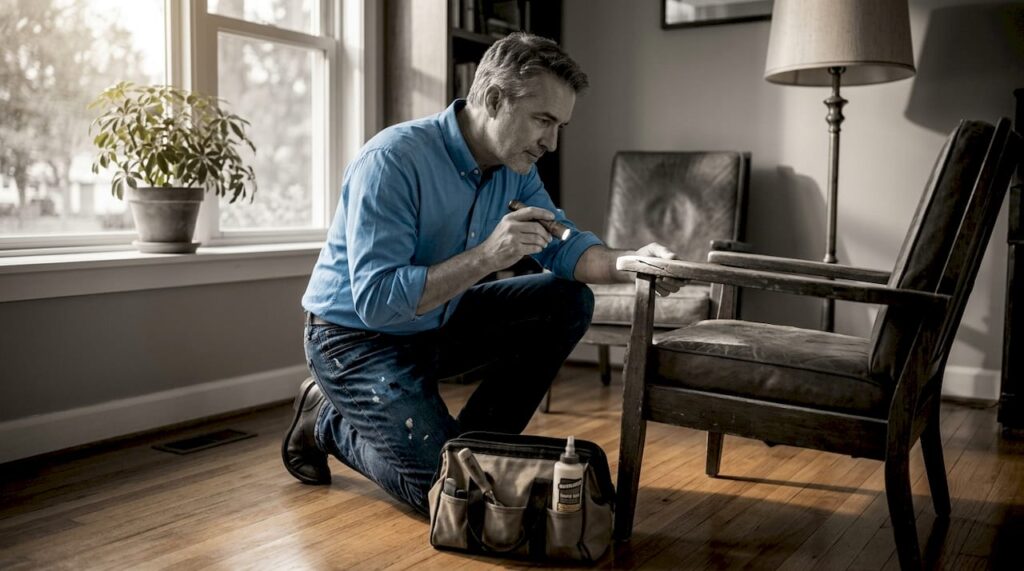
Pro Tip: A UV blacklight is the most reliable tool for locating pet urine deposits that are no longer visible. Pet urine fluoresces under UV light, revealing exactly which areas have been affected — including areas you may not have been aware of. This step takes two minutes and can completely change your understanding of what you are dealing with.
Treating biological odors: pet urine, vomit, and similar
Enzyme-based cleaners are the correct tool for biological odors. Enzymes work by breaking down the organic compounds that cause odor at a molecular level, rather than covering or masking them. The result is actual elimination of the odor source rather than temporary suppression.
Application process for enzyme cleaners on fabric upholstery:
- Blot any remaining liquid thoroughly with clean towels. Do not rub — this spreads the contamination.
- Apply the enzyme cleaner generously enough to saturate the same layers the original liquid penetrated. If urine soaked through to the foam, the enzyme cleaner needs to reach the foam to be effective.
- Allow full dwell time — typically 10 to 15 minutes minimum, longer for severe cases. The enzymes need time to work.
- Blot excess cleaner and allow to dry fully before evaluating. The final result after full drying is what matters.
- Repeat if necessary. Severe or old deposits may require two to three applications.
A quality enzyme pet odor eliminator is the single most effective product for biological couch odors. If you own pets and they have access to your furniture, this is worth having on hand before you need it.
Treating non-biological odors: musty, smoke, food
Non-biological odors do not respond to enzyme cleaners because they are not caused by organic decomposition. They require a different approach.
Baking soda is the most accessible and effective first step for these odors. Apply a generous layer of dry baking soda across the affected surface and work it gently into the fabric with a soft brush. Leave it for at least four hours, or overnight for significant odors. Vacuum thoroughly.
For smoke odor, white vinegar diluted 50/50 with water, applied by spray bottle and allowed to dry completely, is more effective for penetrating odors. The vinegar smell dissipates as it dries and takes other volatile compounds with it. Do not use vinegar on leather or suede — it can damage both materials.
Activated charcoal placed near or on the sofa draws volatile compounds from the air and from surface materials over time. It is slower than direct treatment but useful as a follow-up measure to remove residual odor after initial treatment.
Sunlight and airflow: the free solution people overlook
UV light from direct sunlight kills odor-causing bacteria and degrades many of the organic compounds responsible for persistent smells. If it is possible to move removable cushions outside to a sunny location for several hours, the combination of UV exposure and fresh airflow will significantly reduce even stubborn odors that have resisted chemical treatment.
Airflow alone, without UV, also helps. A sofa in a closed, poorly ventilated room accumulates odors that fresh air exchange reduces. Opening windows and using a fan to move air through the room addresses ambient odor accumulation. For mild musty odors, improved ventilation combined with a baking soda treatment often resolves the problem completely without any chemical products.
When surface treatment is not enough
There are situations where surface and fabric-layer treatment cannot reach the source, and where the only complete solution is replacing the affected foam cushion insert.
If a pet urine deposit was not treated when fresh and has had weeks or months to cure in the foam, the concentration of odor compounds in the foam core is beyond what enzyme cleaners applied from the surface can fully address. You can reduce the odor significantly, but complete elimination may not be achievable without removing the contaminated foam and replacing it with new material.
Replacing a foam cushion insert is a straightforward process — remove the cover (most are zippered), pull out the foam, and order a replacement cut to your exact dimensions. New foam resolves the problem permanently and often improves the feel of the cushion at the same time.
My take on couch odor elimination
The number one mistake I see is people buying odor masking sprays and being disappointed when the smell returns in a few days. These products work by depositing perfume compounds that override the odor temporarily. When the perfume fades, the underlying odor is still there because nothing was done to eliminate it. They are not the wrong product. They are a product designed to do something different from what people expect from them.
If you have a biological odor problem — pet urine being the most common — buy an enzyme cleaner and use it properly. Apply enough of it to reach the depth of the contamination, give it the full dwell time, and let it dry completely before evaluating. Done correctly, a single thorough enzyme treatment usually resolves even significant pet odor problems that years of masking products never touched. The thing I push on with persistent odors that have survived multiple treatments is the foam replacement question. Once you understand that the odor lives in the foam and the cleaning is only reaching the surface, replacing the foam becomes obvious rather than a last resort.
— Dustin
FAQ
Why does my couch still smell after cleaning?
Most persistent couch odors are embedded in the foam cushion fill rather than the surface fabric. Surface cleaning removes what is on the fabric but does not reach the source inside the cushion. Enzyme cleaners applied generously enough to saturate the affected layers, or foam replacement for heavily contaminated cushions, are the effective solutions.
Does baking soda actually remove couch odor?
Yes, for dry surface odors and mild non-biological smells. Apply generously, work into the fabric, leave for several hours, then vacuum. For biological odors like pet urine, baking soda reduces but does not eliminate the smell because it cannot break down the organic compounds the way enzyme cleaners do.
What is the best product to remove pet odor from a couch?
Enzyme-based pet odor eliminators are the most effective products for pet urine and biological odors. They break down odor-causing compounds at the molecular level rather than masking them. Apply generously, allow full dwell time, and let dry completely for best results.
How do you get old urine smell out of a couch?
Old, set urine deposits require generous enzyme cleaner application that reaches the depth of the original contamination. For deposits that have cured over months, multiple treatments may be necessary. If the foam core is heavily saturated, replacing it is often more effective than continued surface treatment.
Can I use vinegar to remove couch odor?
White vinegar diluted with water is effective for smoke, food, and musty odors on fabric upholstery. Do not use vinegar on leather or suede. Apply by spray bottle, allow to dry completely — the vinegar smell dissipates as it dries and takes volatile odor compounds with it.